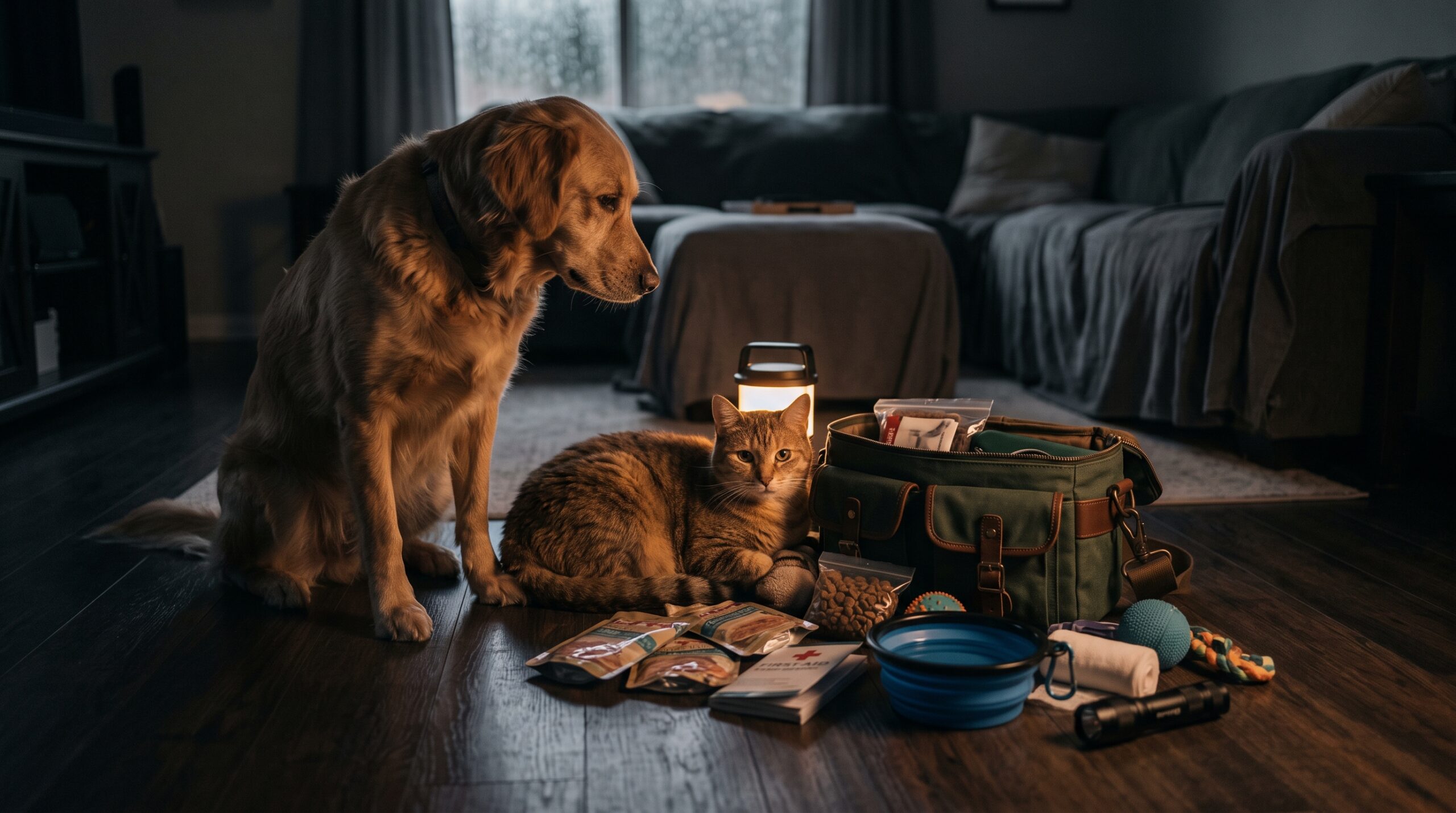
The core of preparing for a power outage with pets is short: keep them with you, and keep a few days of their essentials packed and ready to grab. Federal guidance is blunt about the first half. If it is not safe for you to stay, it is not safe for your pets, so never leave an animal behind when you shelter in place or evacuate (Ready.gov). The rest is a small kit and a plan you put together while the lights are still on.
This guide covers a grab-and-go pet kit, how much food and water to store, keeping pets warm or cool safely, medications and records, calming an anxious animal, and what to do if you have to leave for a shelter. The safety specifics follow Ready.gov, the ASPCA, the AVMA, the CDC, and the American Red Cross. It is planning information, not veterinary advice; for anything tied to your pet’s health or medication, your veterinarian comes first.
⚠️ Heat, cold, and carbon monoxide are the real dangers for pets
When the AC or furnace is off, pets can overheat or chill faster than people, and the warning signs are easy to miss. Never leave a pet in a parked car, even with the windows cracked, because the inside can reach deadly temperatures within minutes (AVMA). Signs of heatstroke include heavy panting, drooling, a deep red or purple tongue, weakness, vomiting, and collapse; move the pet somewhere cooler, offer cool (not cold) water, and call your veterinarian or an emergency clinic right away. Never heat a room or run a generator with a stove, oven, grill, or fuel engine indoors, because the carbon monoxide can be deadly to pets and people alike. Run any generator outdoors only, at least 20 feet from windows, doors, and vents. (Sources: AVMA, CDC)
A pet emergency kit
The heart of pet prep is a kit you can carry, packed before you need it and stored near an exit. Ready.gov suggests keeping two versions: a larger kit for sheltering at home and a lighter one you can grab fast if you have to leave. Build the big one first, then pull a travel copy from it.
Walk down the table below, check off what you already have, and fill the gaps. It pairs with your emergency kit for the household, so the people and the pets are covered from the same shelf.
| What to pack | Why it matters |
|---|---|
| Food and water for several days to two weeks | Sources vary on the number, so pack as much as you can rotate. Use airtight, waterproof containers. |
| Bowls and a manual can opener | Collapsible dishes travel well, and pop-top or hand-opened cans need no power. |
| Medications in a waterproof container | A two-week supply keeps a sick pet covered through a long outage. Rotate it before it expires. |
| Vaccination and medical records, plus registration | Boarding kennels and shelters often ask for proof of vaccination before they take a pet. |
| Microchip number and recent photos | Photos, including one of you with your pet, prove ownership and help reunite you if you are separated. |
| Carrier or crate for each pet | A familiar crate doubles as a safe hiding spot and is the only safe way to move many pets. |
| Leash, harness, and collar with current ID tags | A scared animal bolts; a leash and a readable tag are your backup if it slips away. |
| Litter, litterbox, and cleanup supplies | Cats need a box wherever you end up, and bags and disinfectant handle accidents. |
| Pet first aid kit | Assemble it with your veterinarian so it fits your pet’s needs. |
| A small battery power station | Runs a fan, a light, or a fridge holding pet medicine when the grid is down. |
Water and food
Plan for more than you think you will use. Recommendations differ by source: the CDC and FEMA point to a two-week supply of food and water for each animal, while the AVMA and the Humane Society set a lower floor of roughly three to seven days. The honest answer is to store several days at a minimum and stretch toward two weeks if you have the room. An outage rarely lasts that long, but a stocked shelf means one less errand when stores are closed and roads are bad.
- Keep food in an airtight, waterproof container and rotate it before the expiration date, as the ASPCA and AVMA advise, so it is fresh when you need it.
- Store water for your pets next to your own. A rough planning figure for people is a gallon per person per day; add extra for each animal and refresh it on the same schedule.
- Favor pop-top or single-serving cans, which need no opener and no refrigeration once stored, and pack a manual can opener anyway.
- Keep fresh water in front of your pet the whole time the power is out, especially in the heat, since a warm house dehydrates animals quickly.
Keeping pets warm or cool
With the heat or AC off, the room you pick for yourself is the room for your pets too. Pets overheat and chill faster than people, and the early signs are easy to miss, so keep them close where you can watch them. The same plan that protects you protects them: in the cold, close off and warm one small room; in the heat, block the sun and move low. Our guides on staying warm and staying cool walk through both, and pets fit right into that single-room plan.
- In the cold, give pets extra bedding and a warm spot up off the floor, and watch the ones that lose heat fastest: puppies and kittens, senior pets, small or short-haired breeds, and any animal that is sick.
- In the heat, keep fresh water out, cover sunny windows, and let pets rest on the coolest floor in the house, such as tile in a low room.
- Know the signs of heatstroke. The AVMA lists heavy panting, drooling, a deep red or purple tongue, weakness, vomiting, and collapse. Move the pet somewhere cooler, offer cool (not cold) water, and call your veterinarian or an emergency clinic right away.
- Never leave a pet in a parked car to ride out a hot outage. The inside can reach deadly temperatures within minutes, even with the windows cracked.
- Never warm a room with a stove, oven, grill, or generator indoors. The carbon monoxide is as dangerous to pets as it is to people.
Medications and records
Two small bundles of paper can matter as much as the kit itself. The first is medication: if your pet takes anything daily, keep a two-week supply in a waterproof container and rotate it before it expires, as the ASPCA recommends. If any of it needs refrigeration, ask your veterinarian how long it keeps at room temperature, and consider a small battery station to run a mini-fridge through a long outage.
The second bundle is records. Ready.gov, the AVMA, and the CDC all say to keep copies of your pet’s vaccination and medical records, registration, and microchip number in a waterproof container, along with recent photos, including one of you together. Those photos prove ownership and help reunite you if you are separated, and a boarding kennel or shelter will often ask for proof of vaccination before it accepts your pet. If your pet is microchipped, confirm now that the registry has your current address, phone number, and an out-of-area emergency contact, and if your pet ever goes missing, notify the registry right away.
Keeping pets calm
Storms and outages are stressful for animals, and a frightened pet is harder to keep safe. The ASPCA’s advice starts with a hiding place: set up a small, quiet area such as a bathroom or a covered crate lined with familiar bedding and a favorite toy, and let your pet retreat there. Crate-train ahead of time so the crate already feels safe, and bring pets indoors at the first sign of a storm.
- Stay calm yourself. The ASPCA notes that pets read your mood and settle more easily when you are steady.
- Distract and occupy. A food puzzle or a stuffed Kong, soft music or the TV, and a little play can take the edge off the noise.
- Try calming aids. Pheromone sprays or diffusers and snug pressure wraps help some anxious animals; your veterinarian can point you to what fits.
- Get help for severe fear. If your pet panics in storms, ask your veterinarian or a veterinary behaviorist about a longer-term plan, since phobias tend to worsen if they are ignored.
If you have to evacuate
If you leave, your pets leave with you. Ready.gov’s rule is the one to remember: if it is not safe for you to stay, it is not safe for your pets. The catch is that many public emergency shelters cannot take animals for health and safety reasons, though service animals are allowed, so the time to find a pet-friendly place is before the warning, not after.
- Line up destinations now. Identify pet-friendly hotels along the routes you might take, ask your veterinarian or boarding kennels about emergency options, and check whether friends or relatives outside the area could take your pet.
- Grab the light kit and the carrier. Keep one pet per carrier where you can, and bring the leash, records, food, water, and medications you already packed.
- Tag the door. A rescue-alert sticker by the entrance tells responders how many pets live there; if you leave with them, write “EVACUATED” across it so no one searches an empty house.
- Keep ID on every animal. A collar with a current tag plus a registered microchip is what gets a lost pet home if you are separated in the rush.
Backup power for the basics
You do not need to power the whole house to keep a pet comfortable. A battery power station, which is a large rechargeable battery with normal wall outlets, runs quietly indoors with no exhaust and can cover the few things that matter: a fan in the heat, a light in the safe room, or a mini-fridge holding refrigerated pet medicine. You charge it from the wall before a storm, and unlike a gas generator it is safe to use inside, which keeps the carbon monoxide risk away from animals that cannot tell you they feel sick.
To size one to your real needs instead of a guess, use our Power-Station Sizing calculator to turn the devices you want to run and the hours you want to cover into a capacity target, and the Appliance Runtime calculator to check how long a given battery will keep a specific device going. Enter your own wattages, keep the station charged, and recharge it after every use.
Frequently asked questions
How much food and water should I store for my pet?
Guidance varies, so aim high. The CDC and FEMA suggest a two-week supply of food and water for each animal, while groups like the AVMA and the Humane Society put the floor lower, at roughly three to seven days. A safe target is several days at a minimum and two weeks if you can manage the space. Keep dry or canned food in an airtight, waterproof container, rotate it before it expires, and store water alongside your own. Pop-top cans are handy because they need no opener and no refrigeration once stored.
What should be in a pet emergency kit?
Pack a grab-and-go kit you can carry to a safe room or out the door. Ready.gov and the AVMA list food and water for several days, bowls and a manual can opener, any medications in a waterproof container, copies of vaccination and medical records, your pet’s microchip number, recent photos including one of you together, a sturdy carrier or crate for each pet, a leash and collar with current ID, litter and a litterbox for cats, a pet first aid kit, and familiar toys or bedding. Keep it near an exit so you can move fast.
How do I keep my pet calm during a power outage or storm?
Give your pet a small, quiet place to hide, such as a bathroom or a covered crate lined with familiar bedding and toys, and let them use it. The ASPCA notes that pets pick up on your mood, so staying calm yourself helps. Distract them with a food puzzle or a stuffed Kong, soft music, or a little play. Calming pheromone products and pressure wraps help some animals. For severe storm or noise phobia, ask your veterinarian or a veterinary behaviorist about a longer-term plan, since these fears tend to worsen if ignored.
Can I take my pet to an emergency shelter?
Often not the public one. Many emergency shelters cannot accept pets for health and safety reasons, though service animals are allowed. Plan ahead: identify pet-friendly hotels along your evacuation routes, ask boarding kennels or your veterinarian about emergency options, and line up friends or relatives outside the area who could take your pet. The Red Cross and Ready.gov both stress arranging a safe place before a disaster, not during one.
How do I keep my pet safe when the heat or furnace is off?
Keep pets in the same room where your family rides out the cold or heat, and give them fresh water at all times. In the cold, add extra bedding and watch young, old, small, short-haired, or sick pets closely, since they lose heat fastest. In the heat, the AVMA warns that heatstroke is an emergency; signs include heavy panting, drooling, a deep red tongue, weakness, and collapse. Move the pet somewhere cooler, offer cool water, and call your vet. Never leave a pet in a parked car, and never run a generator or grill indoors.
Sources
- Ready.gov, Prepare Your Pets for Disasters (kit, two-kit approach, never leave pets behind, records): https://www.ready.gov/pets
- ASPCA, Disaster Preparedness (kit contents, food and medication rotation, ID and microchip, caregiver, shelters): https://www.aspca.org/pet-care/general-pet-care/disaster-preparedness
- ASPCA, Keep Your Pet Safe and Calm During Natural Disasters (safe space, calming, hiding): https://www.aspca.org/news/keep-your-pet-safe-and-calm-during-natural-disasters
- AVMA, Pets and disasters (evacuation kit, food and water, records, identification, evacuation site, caregiver): https://www.avma.org/resources-tools/pet-owners/emergency-care/pets-and-disasters
- AVMA, Warm weather pet safety (never leave pets in cars, signs of heatstroke, temperature zones): https://www.avma.org/resources-tools/pet-owners/petcare/warm-weather-pet-safety
- CDC, Build a Pet Disaster Preparedness Kit (two-week supply, records, microchip, carrier, comfort items): https://www.cdc.gov/healthy-pets/emergency-preparedness/preparedness-kit.html
- American Red Cross, Pet Disaster Preparedness & Recovery (planning a safe place, sheltering with pets): https://www.redcross.org/get-help/how-to-prepare-for-emergencies/pet-disaster-preparedness.html