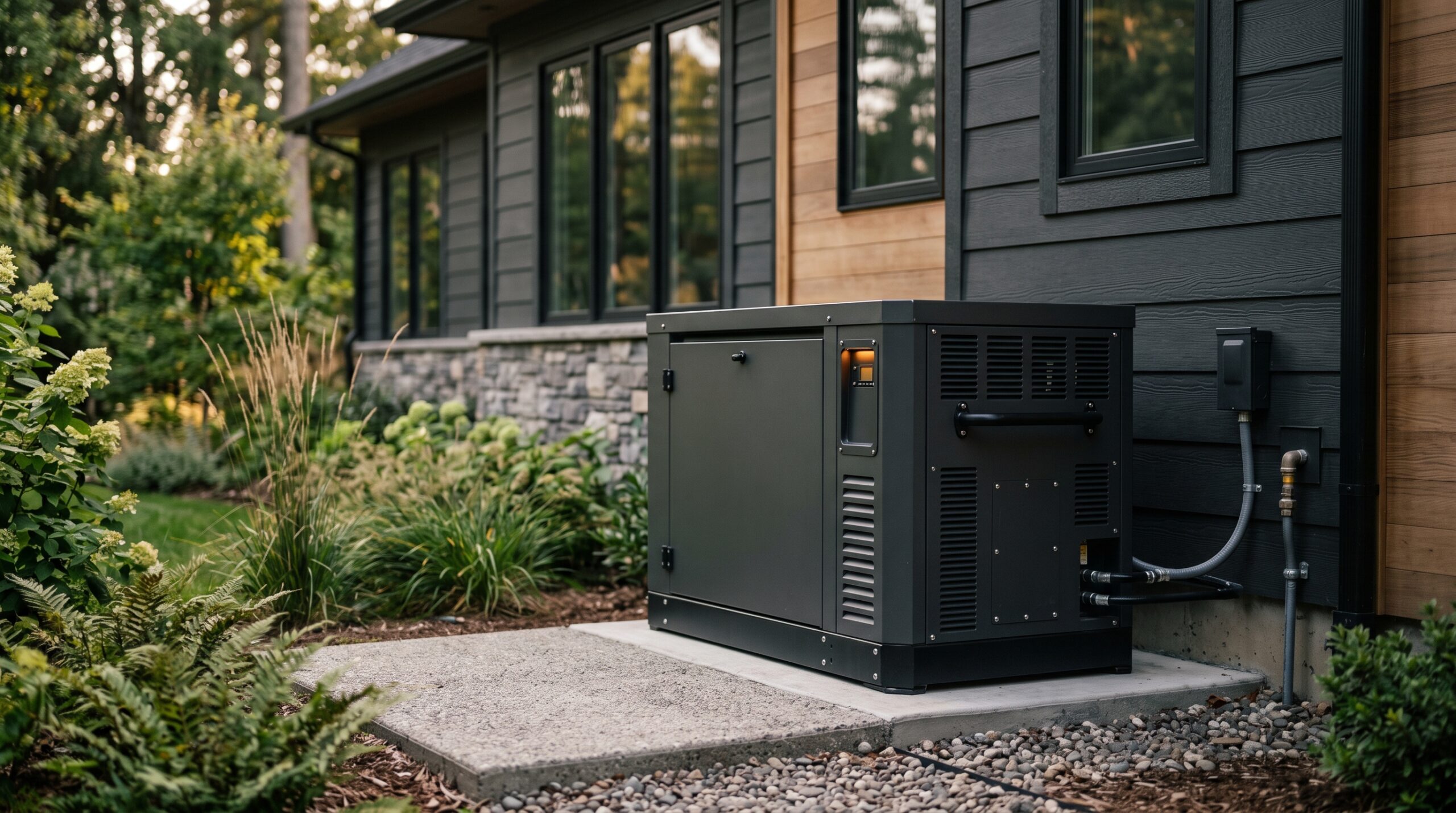
A whole-house standby generator usually runs $7,000 to $15,000 installed, and large liquid-cooled units push well past $20,000. The unit itself is only part of the bill. The transfer switch, labor, concrete pad, fuel line, and permits often add up to as much as the generator. This breakdown shows where the money goes and where a portable generator or a home battery can do the same job for a fraction of the price.
What you’re actually paying for
People shopping for a standby generator often look at the unit price and stop there. That’s the mistake. A 22kW Generac Guardian carries a starting MSRP near $7,000, but the same job done by a licensed electrician and gas fitter, with a pad poured and a permit pulled, routinely lands in the five figures. Installation alone tends to make up 35% to 50% of the total.
Six things drive the total:
- The standby unit — sized in kilowatts. Bigger means more circuits covered and a higher price.
- The automatic transfer switch (ATS) — the device that disconnects from the grid and starts the generator on its own.
- Labor — electrical work, gas fitting, and startup, usually the single largest line item.
- The pad — a poured concrete or composite base the generator sits on.
- Fuel line work — running and connecting natural gas or propane.
- Permit and inspection — required in most jurisdictions, and not optional if you want it done right.
Cost breakdown by component
Here’s how a typical air-cooled whole-house install breaks down. Figures reflect 2025–2026 ranges from Angi, HomeAdvisor, HomeGuide, and dealer pricing. Your numbers shift with home size, gas-line distance, and local labor rates.
| Component | Typical cost | What changes the price |
|---|---|---|
| Standby unit (10–26kW air-cooled) | $2,000–$6,500 | Size in kW; brand; air- vs. liquid-cooled |
| Automatic transfer switch | $400–$2,000 | Amperage; whole-home vs. essential-circuit |
| Professional installation/labor | $3,000–$7,000 | Panel work, gas fitting, complexity |
| Concrete or composite pad | $400–$1,200 | Site leveling; pad size |
| Gas or propane line work | $15–$25 per linear ft | Distance from meter/tank; trenching |
| Permit + inspection | $50–$300+ | Local jurisdiction (AHJ) fees |
| Typical installed total | $7,000–$15,000 | Larger liquid-cooled: $20,000+ |
Angi puts the average standby install around $5,000, but that average is dragged down by small essential-circuit jobs. For a true whole-house setup with a large air-cooled unit, most homeowners land north of $8,000. A real-world example from one homeowner: a full air-cooled install with automatic switch came in just over $10,000, while the comparable liquid-cooled unit would have cost more than $22,000.
How generator size moves the price
Size is the biggest single variable on the unit itself. Air-cooled residential generators top out around 24–26kW, which covers most homes including central air. Past that, you’re into liquid-cooled territory, which costs far more to buy and install.
- 10–14kW: essentials plus light loads. Unit ~$2,000–$3,500.
- 18–22kW: the popular whole-home range, including AC. Unit ~$4,500–$6,000; installed often $8,000–$14,000.
- 24–26kW: larger homes, multiple HVAC zones. Unit ~$6,000–$7,900.
- 30kW and up (liquid-cooled): big homes, workshops, pool equipment. Installed $20,000–$30,000+.
Don’t guess on sizing. An oversized unit wastes thousands; an undersized one trips under load. Our guide on what size generator to run a whole house walks through the math, or you can run the numbers in the sizing calculator.
The cheaper alternative: portable generator + interlock
If your outages are short and infrequent, a standby unit is overkill. A portable generator paired with an interlock kit gives you real backup power for roughly $1,000 to $3,000 all in. The interlock kit itself is cheap hardware ($50–$150), and a licensed electrician installs the inlet box, back-fed breaker, and interlock plate for $400 to $850 in labor. Add the generator ($800–$1,500 for a mid-size unit) and you have a legal, code-compliant way to power chosen circuits.
The tradeoff: you have to be home to roll it out, start it, and plug it in. It won’t switch on automatically at 3 a.m. during a storm. But for many households that’s an acceptable swap for saving five figures. See how to connect a generator to your house for the interlock-vs-transfer-switch decision.
The quiet alternative: a home battery or large power station
Battery backup has gotten good enough to compete. A large portable power station (2–5kWh) runs a fridge, lights, and electronics through a multi-hour outage for $1,500 to $4,000 with no fuel, no fumes, and no noise. A whole-home battery system like a Tesla Powerwall or EcoFlow Delta Pro Ultra setup costs more — often $10,000 to $20,000+ installed — but it pairs with solar and works silently indoors.
Batteries can’t match a generator’s indefinite runtime on a long outage unless they’re recharging from solar, but they win on convenience for the common case. If you’re torn between the two approaches, read generator or power station for a side-by-side, and the home battery backup cost guide for system pricing.
Ongoing costs people forget
The install price isn’t the end of it. A standby generator is a small engine sitting outside your house, and it needs care.
- Annual maintenance: $200–$650 per year for oil changes, filters, spark plugs, battery test, and a transfer-switch exercise. A service contract bundles this.
- Fuel during outages: a 22kW unit burns roughly 2.5–3.5 gallons of propane per hour. A week-long outage can mean a fuel bill over $1,000. Natural gas is cheaper per hour but you’re metered.
- Warranty: most units include 3–5 years; extended coverage is sold separately.
- Electricity for the battery charger and routine self-tests — minor, but it runs year-round.
A portable generator skips the service contract but still needs oil changes, fresh fuel, and safe storage. Fuel math matters either way — see how much gas does a generator use to estimate outage-day costs.
So which makes sense for you?
It comes down to how often the power goes out and what you’re protecting.
- Frequent, long outages (storm-prone areas, well water, medical equipment): a standby generator earns its cost. Automatic, hands-off, runs for days.
- Occasional outages, tight budget: portable + interlock at $1,000–$3,000 covers essentials.
- Short outages, want quiet/indoor power: a power station or home battery.
- Already have solar: a battery that charges off your panels often makes more sense than burning fuel.
Before you commit to a standby unit, it’s worth pressure-testing the decision against your actual outage history. Our piece on whether a whole-house generator is worth it runs the payback math.
Frequently asked questions
How much does a 22kW whole-house generator cost installed?
A 22kW Generac or comparable air-cooled unit typically runs $8,000 to $14,000 fully installed in 2025–2026. The unit alone is around $4,500–$6,000; the rest is the transfer switch, labor, pad, gas line, and permit. Long gas runs or panel upgrades push it higher.
Why is installation so expensive compared to the unit?
Installation involves a licensed electrician, often a separate gas fitter, a poured pad, a permit, and an inspection. That labor and the transfer switch together usually equal 35% to 50% of the total. Gas-line distance and electrical panel work are the wild cards.
Is a portable generator with an interlock kit really that much cheaper?
Yes. An interlock kit installed by an electrician runs about $400–$850 in labor plus cheap hardware, and a mid-size portable generator adds $800–$1,500. The whole setup lands around $1,000–$3,000 versus $8,000+ for standby. The catch is you operate it manually.
What does it cost to maintain a standby generator each year?
Plan on $200 to $650 a year for routine service — oil and filter changes, spark plugs, a battery check, and a transfer-switch test. Many owners buy a dealer service contract. Add fuel costs during actual outages, which can top $1,000 for a long event on propane.
Should I get a generator or a home battery?
Generators win on long outages and indefinite runtime; batteries win on quiet, fume-free, indoor operation and pair well with solar. Frequent multi-day outages favor a generator. Short, occasional ones favor a battery or power station. Our generator or power station comparison breaks down the tradeoffs.
Sources
- Angi — How Much Does It Cost to Install a Whole-House Generator?
- HomeAdvisor — Cost to Install a Whole-House Generator
- HomeGuide — Whole House Generator Cost
- Angi — Generator Transfer Switch Installation Cost
- Generac — Residential Standby Generators