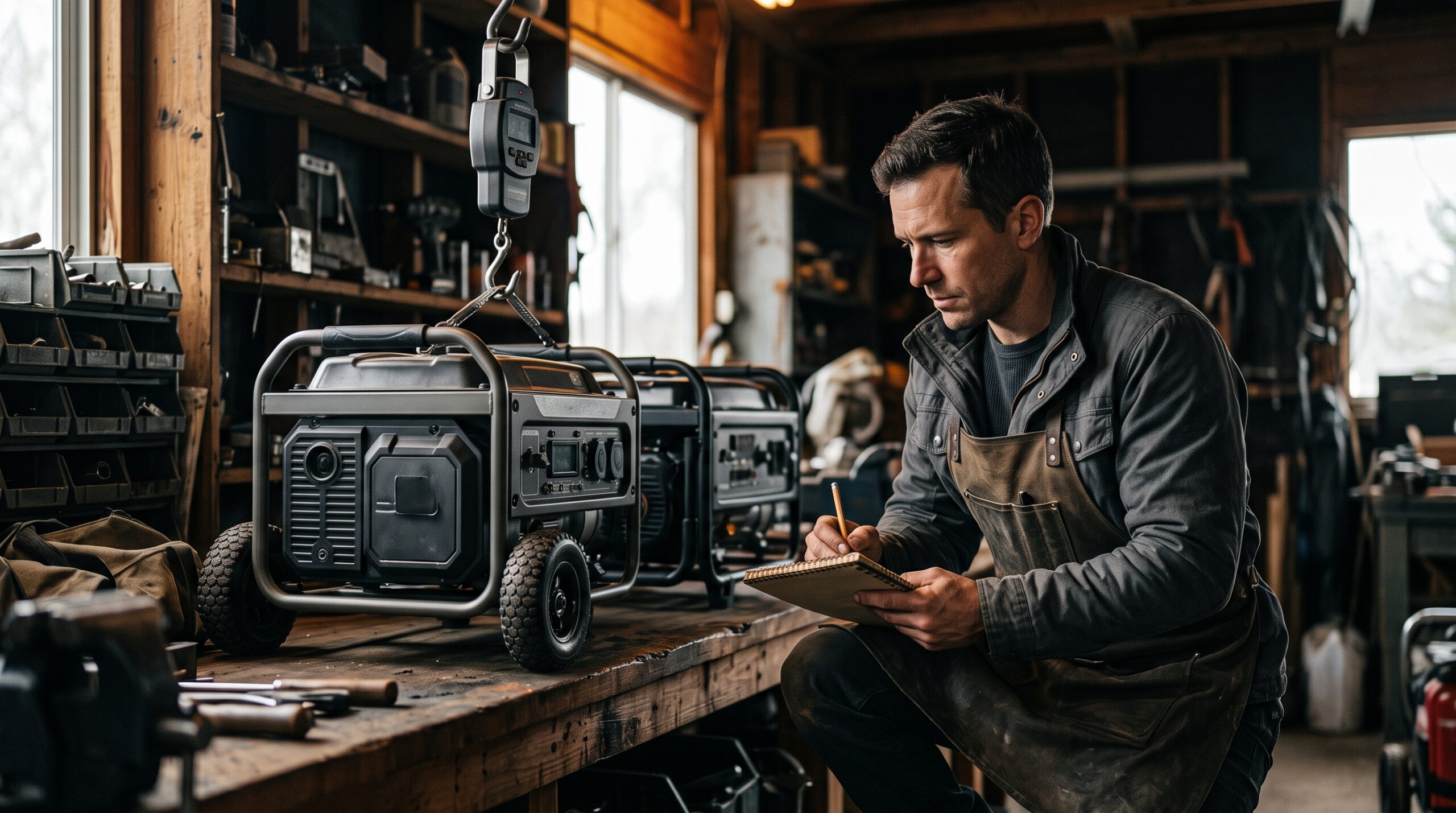
The right generator isn’t the most powerful one on the shelf or the brand your neighbor swears by. It’s the one whose type and output match the loads you actually need to keep running when the power goes out. Get those two decisions right and almost everything else is detail you can sort out afterward.
This guide walks the decision in order: pick the type that fits your situation, size it from your real loads, choose a fuel, then weigh features and budget. Two tools do the heavy lifting along the way: use the sizing calculator to turn your appliance list into a wattage target, and read generator or power station if you’re not sure a fuel-burning generator is even the right tool for you.
Match the generator type to your situation
There are four practical options, and they solve different problems. Sorting them out first saves you from sizing the wrong kind of machine.
- Portable (conventional) generator. The cheapest way to get real wattage. You wheel it out, fuel it, and run extension cords or wire it through a transfer switch. Loud, thirsty, and louder still at full load, but hard to beat on dollars per watt.
- Inverter generator. Quieter and more fuel-efficient because the engine throttles up and down with demand instead of running flat out. The cleaner power is also gentler on sensitive electronics. You pay more for a comparable output. See inverter generator vs conventional generator for the full trade-off.
- Home standby generator. Permanently installed, wired to your panel, and it starts automatically within seconds of an outage. It can carry much or all of a typical home. The catch is cost: the unit plus professional installation is a major purchase, which only pays off if outages are frequent or long.
- Battery power station. An oversized rechargeable battery with outlets. It produces no exhaust, so it’s safe to run indoors, and it’s silent. Runtime is limited by battery capacity rather than a fuel tank, which makes it better for electronics and short outages than for heavy, all-day loads.
Use the table below to find your starting point, then confirm the fit before you shop.
| Your situation | Recommended type |
|---|---|
| Occasional short outages; want a fridge, a few lights, and phone charging on a tight budget | Mid-size portable generator |
| Frequent or multi-day outages; want hands-off, whole-home backup | Home standby generator (professionally installed) |
| Sensitive electronics, CPAP, or camping; quiet operation matters | Inverter generator |
| Apartment or indoor use; no place to store fuel; light loads only | Battery power station |
| Want to run most of the house through your panel without the standby price | Large portable wired through a transfer switch or interlock |
If a battery looks tempting for your loads, settle that question first with generator or power station before going further. Everything below assumes you’ve landed on a fuel-burning generator.
Size it from your load, not a label on the box
The wattage printed on the carton tells you what the generator can deliver, not what you need. Work it the other way: list what you’ll run, add up the power, then leave headroom for the surge. Consumer Reports suggests starting with a list of the devices you want during an outage and adding their wattages to get in the right ballpark.
Most households build the list from the same essentials:
- Refrigerator or freezer
- A few rooms of lights
- Furnace blower or a window AC unit
- Well pump or sump pump, if you have one
- Wi-Fi router, phone chargers, and a medical device such as a CPAP
Here’s the part most buyers miss. Anything with a motor or compressor draws a brief spike of starting watts, often two to three times its running watts, for the split second it kicks on. A fridge, well pump, furnace blower, or AC compressor can all surge well past their steady draw at startup. Your generator has to cover the largest of those surges happening on top of everything else already running, or it will trip and stall. The breakdown in running watts vs starting watts shows how to account for it.
Rather than guess, total your essentials and add the surge with the sizing calculator. It gives you a running-watt and starting-watt target you can shop against. If your goal is to carry the entire home rather than a handful of circuits, what size generator to run a whole house covers how that number climbs.
Choose a fuel that fits how you’ll actually use it
Fuel decides your run time, your storage hassle, and how reliably the generator starts after sitting idle.
- Gasoline. Widely available and common on portables, but it degrades in storage and needs stabilizer, and stations may be down during a regional outage. Stock more than you think you’ll need.
- Propane. Stores indefinitely in sealed tanks, burns cleaner, and starts well in cold weather. You get fewer watts per tank than gas, but the shelf life is a real advantage for prep.
- Dual-fuel. Runs on either gas or propane, so you pick whichever you have on hand. The flexibility is the whole point. See dual-fuel vs gas generator to decide whether it’s worth the small premium.
- Natural gas. The usual choice for home standby units, fed straight from your utility line so you never refuel. It depends on the gas supply staying up, which it usually does.
Run time depends on tank size and how heavily you load the engine, since a generator burns more fuel under heavier draw. If long outages are your worry, weigh expected consumption against your storage; how much gas does a generator use gives realistic figures to plan around.
The features that matter, and the ones that don’t
Once type, size, and fuel are settled, a short list of features separates a safe, livable setup from a frustrating one.
- CO safety shutoff (buy it). Newer portables include a sensor that shuts the engine off when carbon monoxide builds up nearby. It’s a genuine safeguard worth paying for, but it does not make a generator safe to run indoors or close to the house. The CPSC is blunt on this: run portable generators outside only, well away from the home, with exhaust pointed away from windows and doors.
- Transfer switch or interlock compatibility. This is how you safely power circuits in your house. A transfer switch (or an approved interlock kit) isolates utility power from generator power so you can’t backfeed the grid, which can kill a lineworker. Never plug a generator into a wall outlet, and have the switch installed by a qualified electrician. How to connect a generator to your house walks through the options.
- Noise. Conventional portables are loud; inverters are noticeably quieter. If close neighbors or sleep matter, the inverter premium buys real peace.
- Electric start. A push-button or key start beats yanking a recoil cord in the cold and dark. Batteries do age, so keep the recoil backup in mind.
- Outlets. Check that the outlet types match your plan. A 120/240V outlet (often L14-30) is what you’ll need to feed a transfer switch; USB ports and standard 120V outlets cover direct cord use.
Carbon monoxide is the one thing this whole category gets people killed over, so treat placement and ventilation as non-negotiable. Read how to use a generator safely and how far a generator should be from the house before your first run, not after.
Budget for the whole setup, not just the unit
The sticker price is only part of what you’ll spend. Build the real number from the parts you’ll actually need.
- Portable setups are the lowest entry cost. Add the price of a transfer switch or interlock with professional installation if you want to power household circuits, plus cords, fuel, and a fuel can or two. The best portable generator for home use guide covers what to look for.
- Inverter generators cost more than conventional portables of the same output, trading dollars for quiet and efficiency. If that trade fits you, start with the best inverter generator picks.
- Home standby systems are a different tier entirely once you include the gas or electrical hookup, the automatic transfer switch, the pad, and the permit and labor. It’s a serious investment that earns its keep when outages are common. See how much a whole-house generator costs for the full picture.
A quick honest note on buying: there are no affiliate links or prices here, because real prices move with model, retailer, and season. Decide your type and size first, then compare current listings from a few sellers on the specific features you settled on above. That order keeps you from overpaying for watts or features you’ll never use.
Put the decision together
Two numbers and one label decide almost everything: your running-watt total, your largest starting surge, and the type that fits your situation. Lock those in and the shortlist shrinks fast. Run your appliance list through the sizing calculator to get the watts, and if a quiet, indoor-safe battery might serve you better than an engine, confirm it with generator or power station before you spend a dollar.
One pick per generator type, live prices


Champion 4500W Dual Fuel Inverter
Gas or propane, electric start, RV ready
$988.62Check price on Amazon →

Champion 9375W Dual Fuel
Home-backup open frame, electric start, gas or propane
$874.99Check price on Amazon →

Generac GP8000E
8,000 running / 10,000 starting watts, electric start
$1,299.00Check price on Amazon →
As an Amazon Associate we earn from qualifying purchases. Prices are pulled automatically from Amazon and may have changed.
Frequently asked questions
What size generator do I actually need?
It depends entirely on your loads, not on a one-size number. Add up the running watts of everything you’ll run at once, then add the starting surge of the biggest motor on top of that total. A few essentials may land in the mid-thousands of watts, while running most of a house pushes much higher. The sizing calculator does the math for your specific list.
Is an inverter generator worth the extra cost?
If you value quiet, want better fuel efficiency, or are powering sensitive electronics, usually yes. If you mainly need raw watts for a fridge and some lights on a budget, a conventional portable stretches your money further. The full comparison is in inverter generator vs conventional generator.
Can I just plug a generator into a wall outlet?
No. Backfeeding through a wall outlet can energize utility lines and kill a lineworker, and it bypasses your home’s safety protections. To power household circuits, use a transfer switch or an approved interlock installed by a qualified electrician. See how to connect a generator to your house.
Should I get a portable generator or a battery power station?
A battery power station is silent, emission-free, and safe indoors, which suits apartments, electronics, and short outages. A fuel generator delivers sustained high wattage for long outages and heavy loads like pumps and AC. Match it to your loads and outage length with generator or power station.
Does a CO shutoff make a generator safe to use near the house?
No. A CO shutoff is a valuable backup, but the sensor only reads the air right at the generator. Exhaust can still reach dangerous levels inside your home before it reacts. Always run a generator outdoors, well away from the house, with exhaust directed away from windows and vents.
Sources
- Consumer Reports — Generator Buying Guide
- Consumer Reports — How to Choose the Right Size Generator
- U.S. Consumer Product Safety Commission — Generators and Engine-Driven Tools (Carbon Monoxide)
- Honda Power Equipment — What Size Generator Do I Need?
- Consumer Reports — Pros and Cons of Inverter Generators