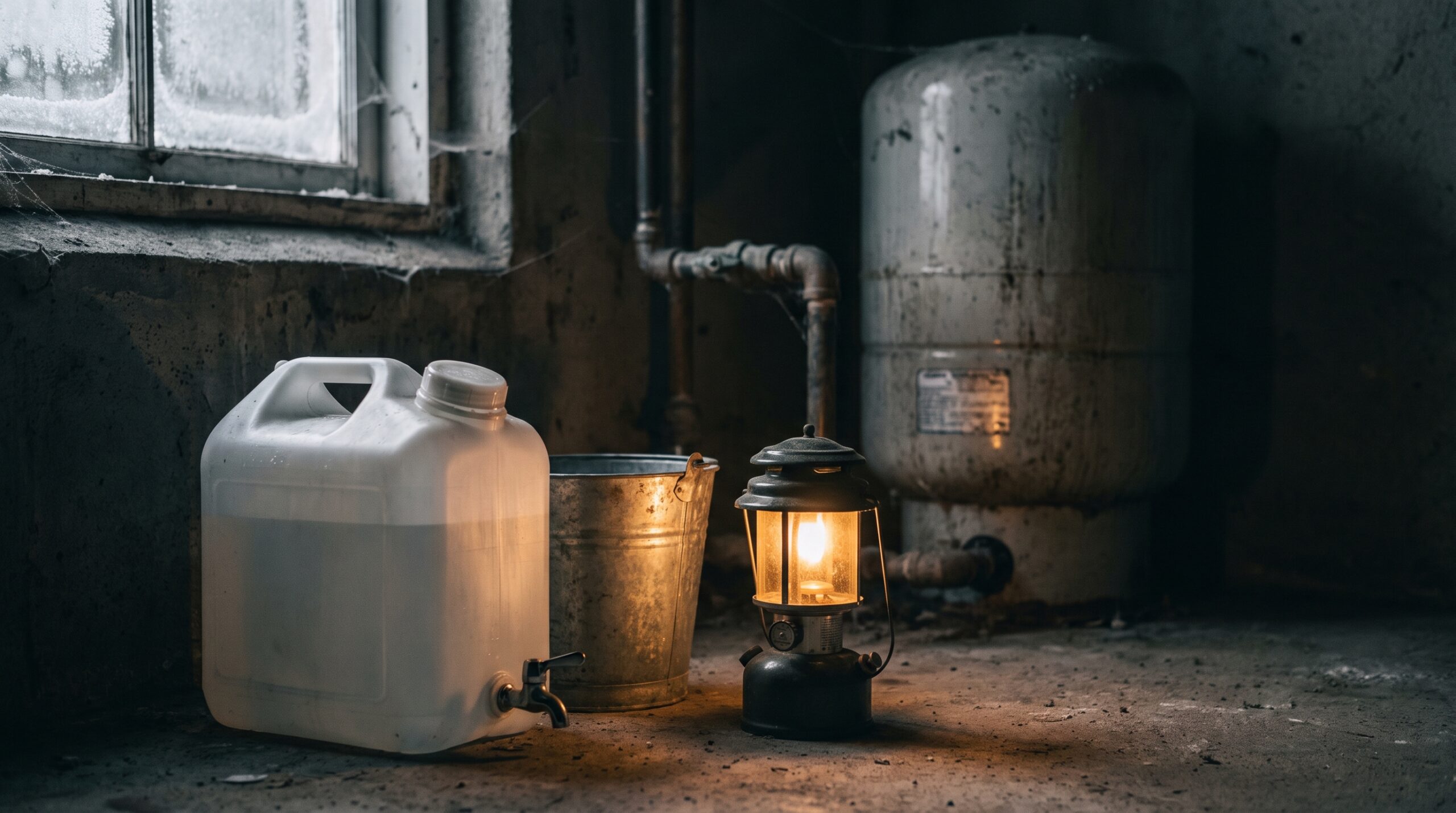
When the power goes out, a private well stops pumping, so you only get the water already in the pressure tank and pipes, unless you stored water ahead or have backup power for the pump. Ready.gov recommends at least one gallon of water per person per day for several days (Ready.gov, Water). The EPA estimates more than 23 million U.S. households rely on private wells (EPA, Private Drinking Water Wells).
Amtrol’s Well-X-Trol chart lists only 5.4 gallons of usable drawdown from a common 20-gallon tank at a 40/60 psi switch setting (Amtrol Well-X-Trol specifications), so the tank alone rarely covers a day of household use. The practical options, in order, are stored water, emergency sources already in the house, then powering or hand-pumping the well. For the broader picture, see power outages and well water and how long a pressure tank lasts without power.
Option 1: Use water you already stored
Ready.gov’s baseline is one gallon per person per day for drinking and basic sanitation, with more for hot weather, pregnancy, sickness or pets (Ready.gov, Water). The EPA puts average home water use at about 82 gallons per person per day (EPA WaterSense), so outage storage is a survival buffer, not a normal-use supply.
| Household | Ready.gov minimum (3 days) | Ready.gov longer (7 days) | Notes |
|---|---|---|---|
| 2 people | 6 gallons | 14 gallons | Drinking and basic sanitation only |
| 4 people | 12 gallons | 28 gallons | Add more for pets and cooking |
| 4 people + pets | 15+ gallons | 35+ gallons | Pets need their own gallons |
Food-grade jugs with spigots pour easily in the dark. Keep them cool, out of sunlight, and rotate on the maker’s schedule:
Drinking-water storage containers, live prices
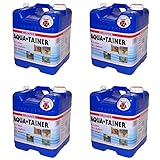
Reliance Aqua-Tainer 7 gal (4-pack)
28 gallons of drinking-water storage across four jugs with spigots
$130.50Check price on Amazon →
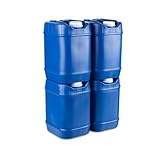
Saratoga Farms 5-gal stackable (4-pack)
20 gallons in stackable containers for a closet or garage
$119.98Check price on Amazon →
As an Amazon Associate we earn from qualifying purchases. Amazon prices as of Nov 27, 6:11 AM ET. Prices and deals change often; the price on Amazon at checkout applies.
For the full storage plan, see how much water to store and how to store water for an emergency.
Option 2: Use emergency water already in the house
- Fill pitchers and pots while pressure lasts if the outage just started and the tank still has drawdown.
- Use the water heater tank. Many homes have 30 to 50 gallons in the heater. Shut off power or gas to the heater first, then drain from the bottom valve into clean containers. See emergency water sources in your home.
- Save toilet-tank water (not the bowl) for non-drinking uses such as flushing, only if the tank is free of cleaner tablets and has not been contaminated.
- Treat questionable water before you drink it. The CDC says boiling is the surest method when the water looks clear: bring it to a rolling boil for 1 minute (3 minutes above 6,500 feet), then cool (CDC, Making Water Safe).
If your well flooded or lost pressure, do not drink from the system until the water has been tested. The EPA and CDC treat flooded private wells as contaminated until testing says otherwise.
Personal water filters for treated emergency water, live prices

Sawyer Mini water filter
Personal filter; maker claims removes bacteria and protozoa down to 0.1 micron
$28.99Check price on Amazon →
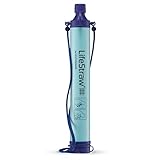
LifeStraw Personal water filter
Maker says 0.2 micron, removes bacteria and parasites; up to 1,000 gal (4,000 L)
$17.95Check price on Amazon →
As an Amazon Associate we earn from qualifying purchases. Amazon prices as of Nov 27, 9:53 AM ET. Prices and deals change often; the price on Amazon at checkout applies.
Option 3: Power the well pump
A power station or outdoor generator can refill the pressure tank when it matches the pump’s voltage and starting surge. Franklin Electric lists a 1/2 HP 230V 2-wire submersible at about 7,400 VA at start (Franklin Electric AIM Manual). Most deep-well pumps need 240V, so a 120V-only station will not run them.
| Approach | Works when | Limits |
|---|---|---|
| 120/240V power station through a transfer switch or interlock | Pump voltage and surge fit the station | Battery size limits pump-hours; hard-wired pumps need an electrician |
| Outdoor portable generator through a transfer switch or interlock | Days-long outages, larger pumps | Fuel, outdoor placement, CO risk |
| Stored water only | Short outages | No pressure at taps once the tank is empty |
Check your pump’s watts and voltage in how many watts a well pump uses, then compare can a power station run a well pump, best power station for a well pump and what size generator for a well pump.
Power stations in the well-pump class (check 240V and surge), live prices

Black Friday Deal
Growatt HELIOS 3600
3,686Wh, 3,600W at 120V; one 240V NEMA 6-20 outlet up to 2,200W (maker spec)
$1,139.00Check price on Amazon →
List price $1,599.00, 29% off (Amazon)
As an Amazon Associate we earn from qualifying purchases. Amazon prices as of Nov 27, 9:53 AM ET. Prices and deals change often; the price on Amazon at checkout applies.
Portable generators sized for well-pump starts, live prices

Champion 9375W Dual Fuel
9,375 starting / 7,500 running W on gasoline, CO Shield
$874.99Check price on Amazon →

Westinghouse 12500W Dual Fuel
12,500 peak / 9,500 running W (gas), 120/240V 14-50R
$999.00Check price on Amazon →
As an Amazon Associate we earn from qualifying purchases. Amazon prices as of Nov 27, 9:53 AM ET. Prices and deals change often; the price on Amazon at checkout applies.
Generators belong outdoors only. Ready.gov says keep them at least 20 feet from windows, doors and attached garages, and install carbon monoxide detectors with battery backup. Read the carbon monoxide safety guide before you run one.
⚠️ Carbon monoxide: run fuel-burning equipment outdoors only
Generators, grills, camp stoves, and other gasoline-, propane-, or charcoal-burning devices give off carbon monoxide, an odorless, colorless gas that can kill within minutes. Never use them inside your home, garage, carport, or basement, or near doors, windows, or vents, even with doors and windows open. Keep a portable generator outdoors at least 20 feet from the house with the exhaust pointed away, and install battery-operated or battery-backup CO alarms. If an alarm sounds or anyone feels dizzy, weak, or sick, get to fresh air right away and call 911. Read our carbon monoxide safety guide (based on CDC and U.S. CPSC guidance).
⚠️ Panel, transfer switch, and interlock work: hire a licensed electrician
Installing a transfer switch, a generator interlock kit, a power inlet box, or any connection to your home’s electrical panel is a job for a licensed electrician, and most areas require a permit and inspection. Never backfeed a generator or power station through a wall outlet: it can energize utility lines and electrocute line workers. Power Outage Planner is not an electrical contractor, and this page is general information, not installation advice.
Option 4: A hand pump (shallow wells and cisterns)
A pitcher-style hand pump can lift water from a shallow well or cistern without electricity. Maker listings for common cast-iron pitcher pumps list about 25 feet of maximum suction lift, so they will not reach a deep drilled well. A deep-well hand pump or cylinder needs a well contractor to size and install it on your casing.
Shallow-well pitcher pumps (about 25 ft lift), live prices

Simmons No.2 pitcher pump
Cast-iron shallow-well pitcher pump; makers list about 25 ft maximum lift
$88.99Check price on Amazon →
As an Amazon Associate we earn from qualifying purchases. Amazon prices as of Nov 27, 9:53 AM ET. Prices and deals change often; the price on Amazon at checkout applies.
Have a licensed well contractor confirm depth, casing and sanitary seal before you change anything on the wellhead.
What to do in the first hour
- Stop non-essential water use (laundry, dishwasher, long showers) so any remaining tank pressure goes to drinking and cooking.
- Fill clean containers while pressure lasts.
- Switch to stored water for drinking once the taps slow to a trickle.
- Flush toilets with a bucket of non-drinking water poured into the bowl instead of refilling the tank from the line.
- Plan backup power or a hand pump if the outage will last more than a day.
- After flooding, treat the well as unsafe to drink until tested (EPA private wells).
On a septic system? See septic systems during a power outage for when flushing is safe and how to restart a septic pump.
Treating water from a bucket or an open source? See the best emergency water filters and why CDC says to disinfect after filtering.
Free storm warning emails for well owners: Enter your ZIP. When the National Weather Service issues a storm warning for your county, you get an email in time to fill water before the pump stops. Check your ZIP →
Frequently asked questions
How do you get water from a well when the power is out?
Use stored drinking water first. A pressure tank only gives its drawdown (Amtrol lists 5.4 gallons from a 20-gallon tank at 40/60 psi). For longer outages, power the pump with a matched power station or outdoor generator through a transfer switch, or use a hand pump sized for your well depth.
How long will a well pressure tank last without power?
Only as long as the drawdown. Amtrol’s chart shows 5.4 gallons for a 20-gallon tank and 11.8 gallons for a 44-gallon tank at 40/60 psi. That is minutes of normal use, not hours. See our pressure-tank guide.
Can a power station run a well pump?
Sometimes. The station must match the pump’s voltage (often 240V) and cover the starting surge. Franklin Electric lists about 7,400 VA to start a 1/2 HP 230V 2-wire motor. Many 120V-only stations cannot run a deep-well pump at all.
Is a pitcher hand pump enough for a deep well?
Usually not. Common pitcher pumps list about 25 feet of suction lift. Deep drilled wells need a deep-well hand pump or cylinder installed by a well contractor.
How much water should a well household store?
Ready.gov recommends at least one gallon per person per day for several days. Well homes should lean toward the longer end of that range because there is no municipal pressure to fall back on.
Is well water safe to drink after an outage?
If the well did not flood and pressure held, the water in the tank is the same water you normally drink. If the well flooded or lost all pressure, do not drink it until it has been tested.
Sources
- Ready.gov, Water
- EPA, Private Drinking Water Wells
- EPA WaterSense, Statistics and Facts
- Amtrol, Well-X-Trol Specifications
- Franklin Electric, AIM Manual: Submersible Motors (Table 3 generator sizing; Table 29 motor specs)
- CDC, Making Water Safe in an Emergency
- Ready.gov, Power Outages
Run your own numbers
Size a power station for your well pump and the rest of your outage loads.