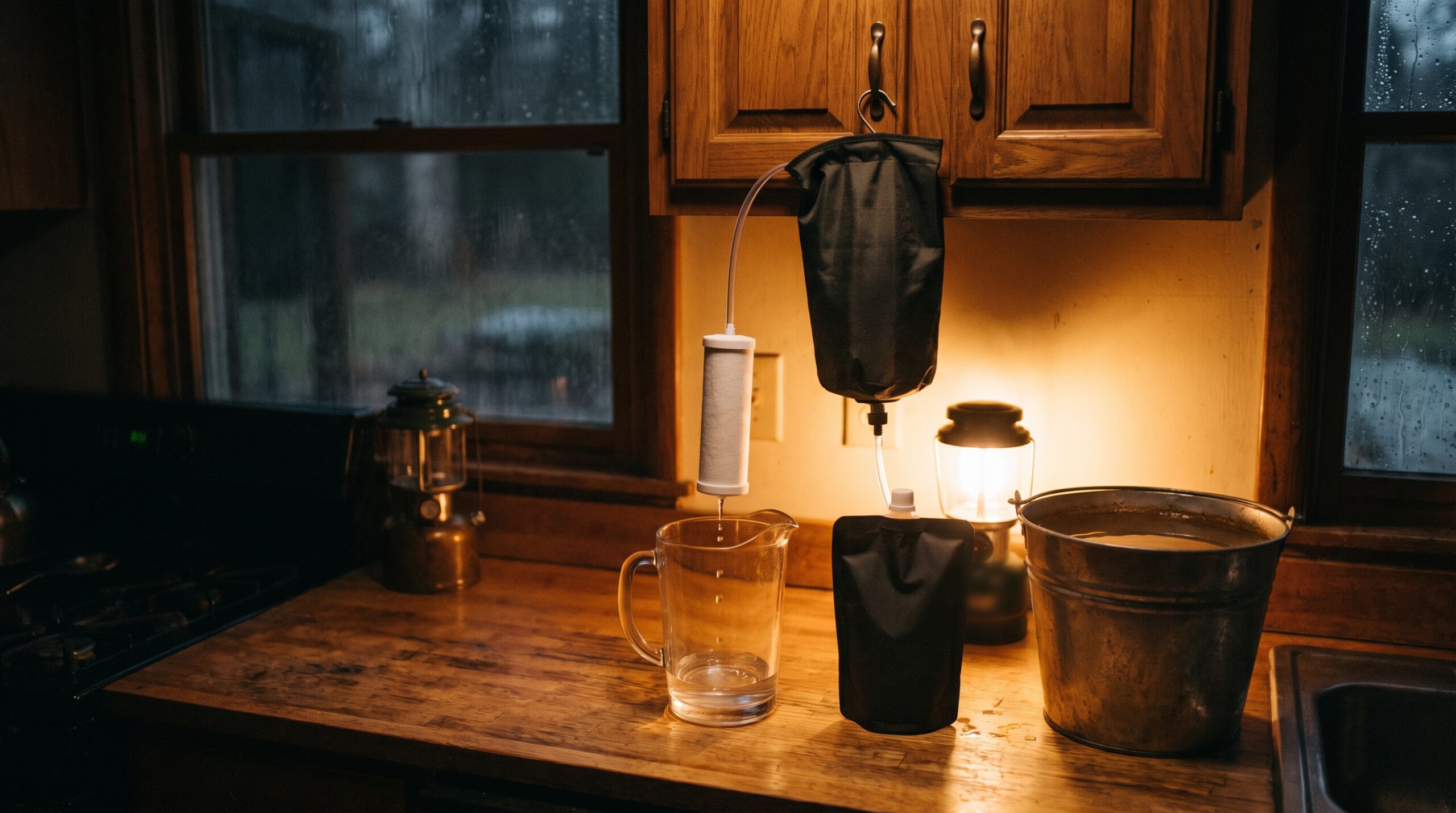
The best emergency water filter has holes small enough to catch bacteria and parasites, and you still disinfect the water afterward. CDC says portable filters will not remove viruses, so add bleach or water-treatment tablets after filtering, or boil the water. (CDC, How to Make Water Safe in an Emergency)
Boiling is still the best way to kill germs, according to CDC. A filter is for when you can’t boil, or when the water is murky and needs clearing first. Plan for at least 1 gallon of water per person per day, as Ready.gov advises, and store that first: see how much water to store for a power outage.
What the label has to say
Here are the label terms CDC tells you to look for, in plain words. “Micron” is the size of the holes in the filter; smaller holes catch smaller germs.
| What the label says | What it removes (CDC) | What it misses |
|---|---|---|
| “Absolute pore size 1 micron or smaller” or “NSF 53 or 58 cyst reduction” | Parasites such as Giardia and Cryptosporidium | Viruses and some bacteria |
| “Absolute pore size 0.3 micron or smaller” | Bacteria and parasites | Viruses |
| “Purifier” (meets EPA purifier testing) | Bacteria, viruses and parasites, per the maker’s own testing | Chemicals, unless the maker says otherwise |
| Reverse osmosis | Parasites, bacteria and viruses, plus salt | Check whether it needs power or water pressure to run |
One catch on “purifier”: the CDC Yellow Book says makers who claim the EPA purifier standard must test their own products to show they remove at least 99.9999% of bacteria, 99.99% of viruses and 99.9% of Cryptosporidium or Giardia, and EPA does not check those claims itself. CDC also says no filter, boiling or disinfectant makes water with chemicals, fuel or radioactive material safe. Use stored or bottled water if that could be in it, for example after a flood.
Which type of filter fits an outage
| Type | How it works | Good for | Downside |
|---|---|---|---|
| Squeeze filter | Fill a pouch, squeeze water through the filter | One or two people, small kits, cheap backup | Slow for a whole family |
| Gravity filter | Hang a bag of dirty water and let it drip through | Families; you can do other things while it runs | Needs a hook or high spot, and setup |
| Hand pump | Pump water from a bucket or stream | Shallow or awkward water sources | More moving parts, costs more |
| Purifier bottle | Press water through a cartridge that also stops viruses | Doubtful water where you can’t boil or treat | Small batches; cartridges wear out |
| Filter straw | Drink straight through it | A go-bag or car kit | Can’t fill a pot or bottle for cooking |
Most homes do fine with a squeeze or gravity filter plus a bottle of unscented bleach or water-treatment tablets. Many squeeze filters also screw onto a gravity bag, which lets one filter serve a family.
Picks by type
Pick the filter type first, then a product. All specs and claims below are the makers’ own.
Squeeze and bottle filters
Squeeze and bottle water filters, live prices

Katadyn BeFree 0.6L
0.1 micron hollow-fiber bottle filter, 2 L/min and 1,000 L capacity per Katadyn
$43.72Check price on Amazon →
As an Amazon Associate we earn from qualifying purchases. Amazon prices as of Nov 26, 7:35 PM ET. Prices and deals change often; the price on Amazon at checkout applies.
Gravity and pump filters
Gravity and pump water filters, live prices

Black Friday Deal
LifeStraw Home 18-cup dispenser
Countertop gravity filter; 0.2 micron membrane meets NSF P231 for bacteria and parasites per LifeStraw
$49.35Check price on Amazon →
List price $64.95, 24% off (Amazon)
As an Amazon Associate we earn from qualifying purchases. Amazon prices as of Nov 27, 3:36 AM ET. Prices and deals change often; the price on Amazon at checkout applies.
Purifier (also removes viruses)
Water purifier bottle, live prices

GRAYL GeoPress 24 oz purifier
Maker says it removes viruses, bacteria and protozoa; cartridge good for 65 gal (250 L)
$99.95Check price on Amazon →
As an Amazon Associate we earn from qualifying purchases. Amazon prices as of Nov 26, 7:35 PM ET. Prices and deals change often; the price on Amazon at checkout applies.
How to make water safe with a filter, step by step
- Use your cleanest water first. Stored water, then water you can get from inside the house. See emergency water sources in your home.
- Clear cloudy water. CDC says to let it settle, or run it through a clean cloth, paper towel or coffee filter, before you treat it. This also keeps your filter from clogging early.
- Filter it the way the maker’s instructions say. CDC repeats this for every filter. Keep the dirty side and the clean side apart.
- Disinfect the filtered water. CDC says to add a disinfectant such as iodine, chlorine or chlorine dioxide after filtering to kill viruses and bacteria. For bleach, follow the label, stir and let it stand at least 30 minutes (CDC). Our water purification guide has the bleach amounts.
- Or boil it if you have a safe way to heat water: see how to boil water without power.
- Store treated water in clean, sanitized containers with tight lids, as CDC advises, and keep it apart from untreated water.
- Clean or replace the filter on the schedule in its manual, and read the manual’s storage and freezing instructions before winter.
Iodine is not for everyone
CDC says people who are pregnant, have thyroid problems or are sensitive to iodine should avoid iodine-treated water, and no one should drink it for more than a few weeks at a time. Chlorine bleach or chlorine dioxide tablets are other options. Ask a doctor or pharmacist if you are unsure.
If your water comes from a well
A private well stops pumping when the power goes out, and floodwater can contaminate it. A filter helps with the water you can still reach, but the bigger fix is getting water out of the well at all. Read how to get water from a well without power and power outages and well water. To keep the pump running, the best power station for a well pump guide covers sizes.
Put the filter in your kit with stored water: the emergency kit builder makes a list for your household, and our power outage safety tips cover the rest.
Frequently asked questions
What is the best water filter for emergencies?
One with an absolute pore size of 0.3 micron or smaller, which CDC says removes bacteria and parasites. Then disinfect the filtered water with bleach or tablets, because CDC says portable filters do not remove viruses. A purifier rated for viruses skips that step, per its maker.
Do water filters remove viruses?
Most portable filters do not. CDC says to add a disinfectant such as chlorine, iodine or chlorine dioxide after filtering. Purifiers that meet EPA purifier testing claim to remove viruses, based on the maker’s own tests.
Is a filter better than boiling water?
No. CDC says boiling is the best way to kill germs. The next best option is to filter the water and then disinfect it.
Can a water filter make floodwater safe?
Not reliably. CDC says boiling, filtering or disinfecting cannot make water with chemicals or toxins safe. Use stored or bottled water if floodwater or fuel could have reached your source.
How much water should I plan to filter?
Ready.gov says to plan for at least 1 gallon per person per day. Store as much as you can first and keep a filter as backup.
What do NSF 53 and 58 mean on a water filter?
CDC says a filter certified to NSF Standard 53 or 58 for cyst reduction or removal will remove parasites such as Giardia and Cryptosporidium. It will not remove viruses or all bacteria.
Sources
- CDC, How to Make Water Safe in an Emergency
- CDC, About Water Treatment Options When Hiking, Camping, or Traveling
- CDC Yellow Book, Water Disinfection for Travelers
- Ready.gov, Water
- Ready.gov, Power Outages
Run your own numbers
On a well? Add your well pump and the other things you want to keep running to see what size backup power you need.