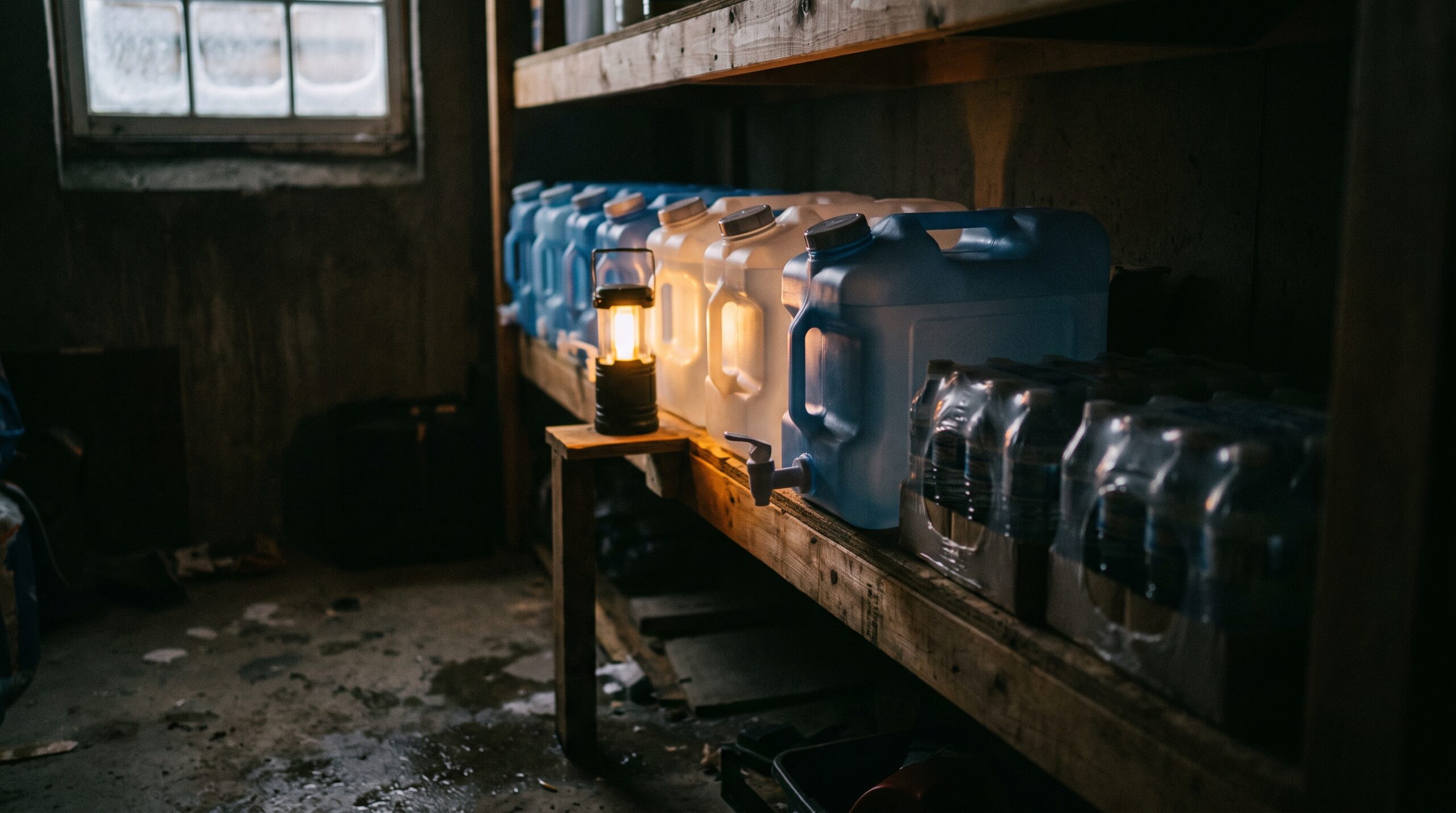
The best emergency water container is one that is food-grade, closes tightly and is easy for you to lift and pour. The CDC says to store at least 1 gallon per person per day for 3 days, and a 2-week supply if you can. (CDC) Sealed store-bought bottled water is the simplest choice. For tap water you bottle yourself, 5-gallon food-grade jugs are the usual pick.
Ready.gov gives the same rule: buy commercially bottled water and keep it sealed in a cool, dark place, or buy food-grade containers if you fill your own (Ready.gov). Below: which kind of container fits your home. For how to clean, fill and rotate them, see how to store water for an emergency.
How much water to store
These totals use the CDC minimum of 1 gallon per person per day (CDC). The CDC says to store more for people who are pregnant or sick, for pets, and in hot climates. Ready.gov adds that in very hot weather water needs can double.
| Household | 3 days (CDC minimum) | 2 weeks (CDC goal) |
|---|---|---|
| 1 person | 3 gal | 14 gal |
| 2 people | 6 gal | 28 gal |
| 3 people | 9 gal | 42 gal |
| 4 people | 12 gal | 56 gal |
| 5 people | 15 gal | 70 gal |
| 6 people | 18 gal | 84 gal |
A 5-gallon container covers 5 person-days at that rate. So a family of four needs about three 5-gallon jugs for 3 days, or about a dozen for two weeks. See how much water to store for a power outage for the details by household.
Types of emergency water containers
| Container type | Good for | Watch out for |
|---|---|---|
| Sealed bottled water | The easiest start; CDC calls unopened bottled water the safest source | Use by the date on the label (CDC); takes shelf space |
| 5-gallon stackable jugs | Most homes; stack in a closet or basement | Heavy when full; buy a spigot if one is not included |
| 5-gallon military-style cans | Carrying water and tight spaces | Pour slowly without a spout; check the listing says food-grade or BPA-free |
| Collapsible 5-gallon carriers | Small apartments and go-bags; fold flat when empty | Softer walls, so treat them as short-term or backup storage |
| Large drums (about 55 gallons) | A big supply in one place | Too heavy to move once full; you need a pump or siphon to get water out |
For any type, the CDC says to use FDA-approved food-grade water storage containers, which you can find at camping and surplus stores, and to contact the maker if you are not sure a container is food-grade (CDC).
How to choose and set up your containers, step by step
- Work out your target. Multiply people x 1 gallon x days. Start with 3 days and build toward 2 weeks (CDC).
- Pick food-grade containers. If you can’t get one, the CDC says the container should close tightly, be made of a durable material that won’t break (not glass), and ideally have a narrow neck so you can pour.
- Never reuse a container that held chemicals such as bleach or pesticides (CDC).
- Match the size to who will lift it. Full 5-gallon jugs are heavy. Smaller jugs or a spigot you can pour from without lifting help if anyone in the house has trouble carrying weight.
- Wash and sanitize before filling. The CDC method is to wash with soap and rinse, then shake with 1 teaspoon of unscented household bleach (5% to 9% sodium hypochlorite) in 1 quart of water, wait at least 30 seconds, pour it out and let it air-dry. Full steps are in how to store water for an emergency.
- Fill, cap and label. Write “drinking water” and the date on each container (CDC).
- Store it in the right place. The CDC says somewhere cool (50°F to 70°F), out of direct sunlight, and away from toxic things such as gasoline or pesticides.
- Replace it every 6 months if you filled it yourself (CDC, Ready.gov). Store-bought water follows the date on its label.
Stackable 5-gallon water storage, live prices
Saratoga Farms 5-gal stackable (4-pack)
Food-grade, BPA-free HDPE; flat tops so jugs stack (maker listing)
$119.98Check price on Amazon →

Aguaprep 5-gal stackable kit
Food-grade tanks with a spigot and spare lids, made in USA (maker listing)
$154.99Check price on Amazon →
As an Amazon Associate we earn from qualifying purchases. Amazon prices as of Nov 27, 4:39 AM ET. Prices and deals change often; the price on Amazon at checkout applies.
Stackable jugs vs. carry cans vs. collapsible
Stackable jugs make sense when you want the most water in the least floor space. The flat tops let you build a short stack on a shelf or pallet. Get at least one spigot, because pouring from a full 5-gallon jug is awkward.
Military-style cans and square jugs are easier to carry to the kitchen or the car and fit between other things on a shelf. They work well if you also want water you can take with you if you have to leave.
5-gallon carry cans and jugs, live prices
Scepter 5 gal military-style can
BPA-free HDPE, molded handle, 13.7 x 6.8 x 18.8 in (maker listing)
$55.09Check price on Amazon →

FastRack 5 gal Hedpak
Food-grade, BPA-free square jug with a 70 mm cap (maker listing)
$24.49Check price on Amazon →
As an Amazon Associate we earn from qualifying purchases. Amazon prices as of Nov 27, 4:39 AM ET. Prices and deals change often; the price on Amazon at checkout applies.
Collapsible carriers fold flat when empty, so they fit a small apartment or a go-bag. You can keep a couple empty and fill them from the tap when a storm is in the forecast. Treat them as a backup to sturdier jugs, not as your only storage.
Collapsible water carriers, live prices

Wolverine Tuff Bottle 5 gal
Double-wall flexible 5 gal / 20 L container with a pour spout (maker listing)
$23.95Check price on Amazon →
As an Amazon Associate we earn from qualifying purchases. Amazon prices as of Nov 27, 4:39 AM ET. Prices and deals change often; the price on Amazon at checkout applies.
Freeze some of it
The FDA suggests freezing containers of water before an outage. They help keep the freezer, fridge or a cooler cold, and if your normal water is cut off, the melted ice gives you drinking water too (FDA). More on that in the best cooler for a power outage.
Using stored water safely
- Don’t touch the water or the inside of the container with your hands, and use a clean scoop each time if you scoop (CDC).
- If bottled water smells off, don’t drink it. The FDA says to throw it out or ask your bottled water provider for a replacement.
- If you run out, treat water before drinking it. See how to purify water in an emergency, how to boil water without power and the best emergency water filters.
- Look for water you already have. The water heater tank and other sources are covered in emergency water sources in your home.
On a private well, the taps stop when the pump loses power, so stored water matters even more. See how to get water from a well without power and the best power station for a well pump.
Add water to the rest of your plan with the emergency kit builder, the power outage checklist and our power outage safety tips.
Frequently asked questions
What is the best container for emergency water storage?
Sealed store-bought bottled water is the simplest. If you fill your own, the CDC recommends FDA-approved food-grade water storage containers with tight lids. For most homes that means 5-gallon food-grade jugs, ideally with a spigot.
How much water should I store for an emergency?
The CDC says at least 1 gallon per person per day for 3 days, and a 2-week supply if possible. Store more for people who are pregnant or sick, for pets, and in hot climates.
How often should I replace stored water?
The CDC and Ready.gov say to replace water you bottled yourself every 6 months. Store-bought bottled water follows the date on its label.
Can I use old milk jugs or soda bottles for water?
The CDC says not to use containers that held toxic chemicals such as bleach or pesticides. If you can’t get a food-grade container, the CDC says it should close tightly and be made of a durable material that won’t break, not glass. A purpose-made food-grade container is the safer choice.
Where should I keep emergency water?
The CDC says somewhere cool, 50°F to 70°F, out of direct sunlight and away from toxic substances such as gasoline or pesticides.
Are collapsible water containers good for emergencies?
They are handy for small spaces and for filling right before a storm, because they fold flat when empty. Use them as a backup to sturdier food-grade jugs rather than your only storage.
Sources
- CDC, How to Create an Emergency Water Supply
- Ready.gov, Water
- FDA, Food and Water Safety During Power Outages and Floods
Run your own numbers
Planning backup power too? Add a fridge, a well pump or anything else you want to keep running to see what size power station you need.