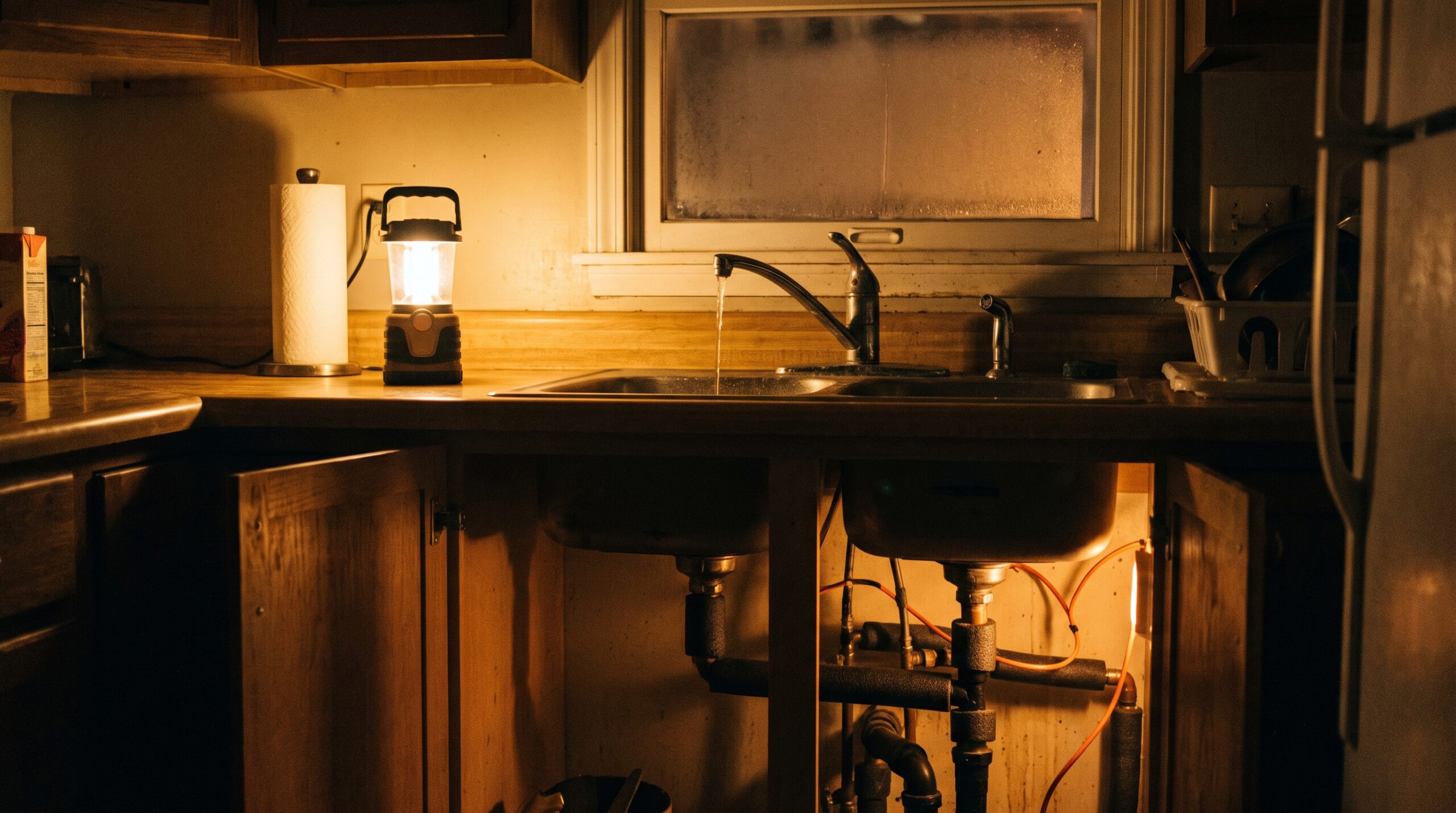
When the heat goes out in freezing weather, let cold water drip from faucets served by exposed pipes and open the cabinet doors under sinks. The American Red Cross says running water through the pipe, even at a trickle, helps prevent freezing, and recommends never letting the thermostat drop below 55°F when you’re away. (American Red Cross, Frozen Pipes)
A power outage turns that advice into a race against the indoor temperature. The furnace, any heat cable and a well pump all stop together. For whole-house prep before winter, see how to winterize your home for power outages.
What to do when the power goes out in freezing weather
- Drip the faucets on exterior walls. Let cold water drip from faucets fed by pipes in exterior walls, unheated rooms or crawl spaces, as the Red Cross recommends. On a private well, the pump stops without power, so dripping only works while the pressure tank lasts.
- Open sink and vanity cabinet doors so warmer room air reaches the plumbing (Red Cross).
- Keep garage doors closed if water lines run through the garage (Red Cross).
- Hold heat in. Close off unused rooms, keep exterior doors shut, and gather in one room. Our how to stay warm during a power outage guide covers this.
- Find your main water shutoff now, before a pipe splits, so you can stop the flow fast.
- Power the loads that protect pipes, such as heat cable, the furnace blower or a well pump, with a power station or an outdoor generator (see below).
- Never heat the house with a gas stove or oven. Ready.gov warns against it (Ready.gov, Winter Weather).
Which pipe-protecting loads can backup power run?
| Load | Power (maker spec or rating) | On a 1,024Wh power station* | Notes |
|---|---|---|---|
| Frost King HC6A heat cable, 6 ft | 7 W/ft × 6 ft ≈ 42 W at 120V | ≈20 hours | Thermostat-controlled, so it cycles on only when cold |
| HEATIT self-regulating cable, 24 ft | 3 W/ft × 24 ft ≈ 72 W at 120V | ≈12 hours | Built-in thermostat: on at 38°F, off at 50°F |
| Gas furnace blower and controls | Varies by furnace; see the nameplate | Varies | See how long a power station runs a furnace |
| 1,500 W electric space heater | 1,500 W | ≈35 minutes | Not practical on a battery. See can a power station run a space heater |
| Well pump | Several kW to start | Usually no | See best power station for a well pump |
*Our calculation: watt-hours × 0.85 inverter efficiency ÷ watts, as if the load ran nonstop. Thermostat-controlled heat cable runs only part of the time, so real runtime is longer. Heat-cable figures come from each maker’s Amazon listing, checked November 3, 2026. The Red Cross says heat tape or heat cable should be UL-listed. Install it exactly as the maker’s instructions say, and never cover or overlap it unless the maker allows it.
Heat cable and a power station to run it, live prices
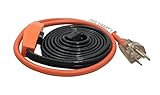
Frost King HC6A heat cable (6 ft)
120V, 7 W/ft (about 42W), thermostat-controlled
$28.79Check price on Amazon →

Black Friday Deal
HEATIT self-regulating heat cable (24 ft)
120V, 3 W/ft, ETL listed, on at 38°F
$26.39Check price on Amazon →

EcoFlow DELTA 3
1,024Wh, 1,800W, 10 ms UPS
$599.00Check price on Amazon →
List price $699.00, 14% off (Amazon)
As an Amazon Associate we earn from qualifying purchases. Amazon prices as of Nov 27, 5:25 PM ET. Prices and deals change often; the price on Amazon at checkout applies.
If you run a generator
A portable generator can keep a furnace, heat cable and well pump going for days, but only outdoors. Ready.gov says to keep generators outdoors and at least 20 feet from windows, doors and attached garages, and to install carbon monoxide detectors with battery backup. Running a furnace or well pump from a generator needs a transfer switch or interlock installed by a licensed electrician. See transfer switch vs interlock.
⚠️ Carbon monoxide: run fuel-burning equipment outdoors only
Generators, grills, camp stoves, and other gasoline-, propane-, or charcoal-burning devices give off carbon monoxide, an odorless, colorless gas that can kill within minutes. Never use them inside your home, garage, carport, or basement, or near doors, windows, or vents, even with doors and windows open. Keep a portable generator outdoors at least 20 feet from the house with the exhaust pointed away, and install battery-operated or battery-backup CO alarms. If an alarm sounds or anyone feels dizzy, weak, or sick, get to fresh air right away and call 911. Read our carbon monoxide safety guide (based on CDC and U.S. CPSC guidance).
⚠️ Panel, transfer switch, and interlock work: hire a licensed electrician
Installing a transfer switch, a generator interlock kit, a power inlet box, or any connection to your home’s electrical panel is a job for a licensed electrician, and most areas require a permit and inspection. Never backfeed a generator or power station through a wall outlet: it can energize utility lines and electrocute line workers. Power Outage Planner is not an electrical contractor, and this page is general information, not installation advice.
How to thaw a frozen pipe safely
Signs of a frozen pipe: you turn on a faucet and only a trickle comes out. The Red Cross steps:
- Keep the faucet open. As the ice melts, flowing water helps melt the rest.
- Apply gentle heat to the frozen section: an electric heating pad wrapped around the pipe, a hair dryer, a portable space heater kept away from flammable materials, or towels soaked in hot water. All of the electric options need power, so a power station helps here. A hair dryer or heater draws a lot, so run it in short bursts.
- Never use an open flame. The Red Cross says not to use a blowtorch, kerosene or propane heater, charcoal stove or other open-flame device.
- Keep applying heat until full water pressure returns.
- Check the other faucets. If one pipe froze, others may have too.
- Call a licensed plumber if you can’t find or reach the frozen section, or can’t thaw it.
⚠️ Space heaters near pipes
The U.S. CPSC advises keeping portable electric heaters at least 3 feet from anything that can burn and plugging them directly into a wall outlet, not an extension cord. Never leave one running unattended (CPSC).
Holding heat in the house also buys time for pipes — see how long a house stays warm without power.
Have a sump pump? Keep its discharge line clear in winter and see the best battery backup sump pumps for outages.
In Michigan, check the Michigan power outage guide for utility outage maps and the state’s outage credit rules.
Free winter storm warning emails: Enter your ZIP. When the National Weather Service issues a winter storm or ice storm warning for your county, you get an email with three things to do before the power goes out. Check your ZIP →
Frequently asked questions
How long does it take for pipes to freeze without heat?
There is no single number. It depends on the outdoor temperature, wind, insulation and where the pipe runs. Pipes in exterior walls, attics, crawl spaces and garages freeze first. Start dripping faucets and opening cabinets as soon as the heat goes out in freezing weather.
Should I drip hot or cold water to keep pipes from freezing?
The American Red Cross advises letting cold water drip from the faucet served by exposed pipes. Running water through the pipe, even at a trickle, helps prevent freezing.
Can a power station run pipe heat cable?
Yes. Heat cable is a small load. A 6 ft Frost King HC6A is rated about 42 W (7 W per foot), which a 1,024Wh station could run for roughly 20 hours even nonstop. Its thermostat means it usually runs less.
Can I use a propane heater to thaw a frozen pipe?
No. The Red Cross says not to use a blowtorch, kerosene or propane heater, charcoal stove or other open-flame device to thaw pipes. Use an electric heating pad, a hair dryer, a space heater kept away from flammables, or hot towels.
What temperature should I keep the house at to protect pipes?
The Red Cross recommends keeping the thermostat at the same temperature day and night, and no lower than 55°F if you’ll be away.
Sources
- American Red Cross, Frozen Pipes
- Ready.gov, Winter Weather
- Ready.gov, Power Outages
- U.S. CPSC, Reducing Fire Hazards for Portable Electric Heaters
Run your own numbers
Check how long your power station runs heat cable, a furnace blower or anything else.