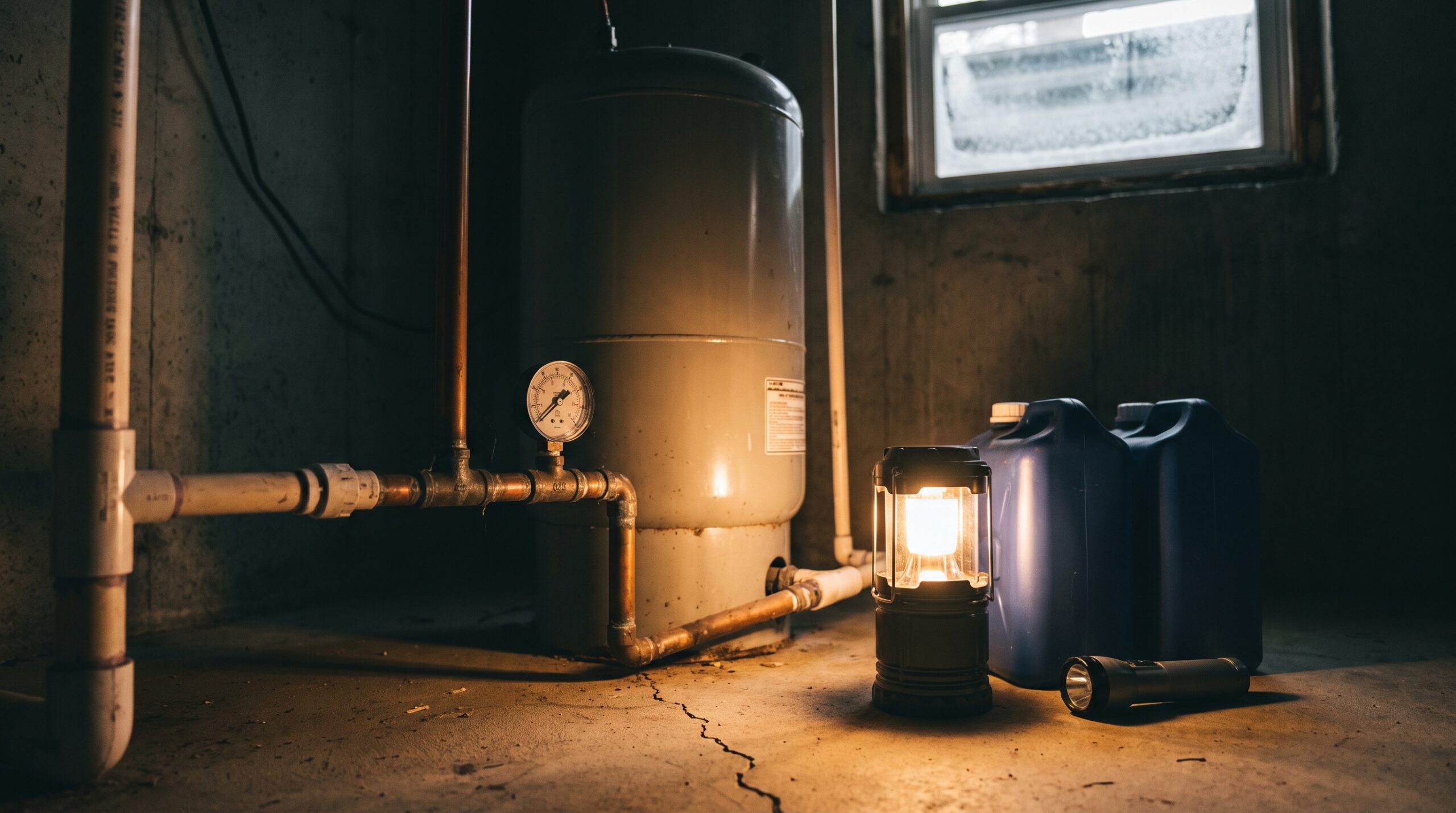
When the power goes out, a well pressure tank gives you only a few gallons of water, often enough for a few toilet flushes and some hand-washing, not a shower. Amtrol’s spec card says a common 20-gallon tank (WX-202) holds about 5.4 usable gallons, and a 44-gallon tank (WX-250) about 11.8 gallons. (Amtrol Well-X-Trol specifications) The EPA says the average American uses 82 gallons of water a day at home (EPA WaterSense), so plan on that stored water running out quickly.
Why so little? Most of a tank is air plus the room the pump needs to switch on and off. The water you can actually use is called the “drawdown.” The Amtrol figures above assume the common 40/60 psi pressure switch setting (psi is the water pressure reading on your gauge). With no power, the pump can’t refill the tank, so the pressure keeps dropping and the taps slow to a trickle. For the bigger picture, see power outages and well water.
How much water a pressure tank holds without power
Drawdown depends on the tank size and on the pressure switch setting. Higher settings give slightly less water from the same tank. These are Amtrol’s published figures for its Well-X-Trol line:
| Amtrol model | Tank volume | Drawdown at 30/50 psi | At 40/60 psi | At 50/70 psi |
|---|---|---|---|---|
| WX-102 | 4.4 gal | 1.4 gal | 1.2 gal | 1.0 gal |
| WX-202 | 20 gal | 6.2 gal | 5.4 gal | 4.7 gal |
| WX-203 | 32 gal | 9.9 gal | 8.6 gal | 7.6 gal |
| WX-250 | 44 gal | 13.6 gal | 11.8 gal | 10.4 gal |
| WX-251 | 62 gal | 19.2 gal | 16.6 gal | 14.6 gal |
| WX-255 | 81 gal | 25.0 gal | 21.7 gal | 19.1 gal |
| WX-350 | 119 gal | 36.8 gal | 31.9 gal | 28.1 gal |
Amtrol notes that drawdown can be affected by temperature, pressure and other system conditions, so treat these as close estimates. Amtrol ships these tanks precharged to 38 psi, 2 psi under a 40 psi cut-in. Other brands publish similar charts. Find your tank’s model number on its label and look it up on the maker’s spec sheet.
What the drawdown covers
Using EPA figures for toilets and showerheads and Ready.gov’s drinking-water guideline:
| Use | Water per use (source) | 20-gal tank at 40/60 (5.4 gal)* | 44-gal tank at 40/60 (11.8 gal)* |
|---|---|---|---|
| Flush, federal-standard toilet | 1.6 gal per flush (EPA) | About 3 flushes | About 7 flushes |
| Flush, WaterSense toilet | 1.28 gal per flush or less (EPA) | About 4 flushes | About 9 flushes |
| Flush, older toilet | Up to 6 gal per flush (EPA) | Less than 1 flush | About 2 flushes |
| Shower, standard showerhead | 2.5 gal per minute (EPA) | About 2 minutes | About 4.5 minutes |
| Drinking water | 1 gal per person per day (Ready.gov) | About 5 person-days | About 11 person-days |
*Our calculation: drawdown ÷ water per use, rounded down. Each row assumes the whole drawdown goes to that one use.
Even the 119-gallon WX-350 gives about 32 gallons at 40/60, well under half of one person’s average daily use at home. A bigger tank buys a little time but does not get you through an outage.
What to do when the power goes out on a well
- Stop non-essential water use right away. No laundry, dishwasher or long showers. Every gallon left in the tank is drinking or cooking water.
- Fill pitchers and pots first while there is still pressure, so the last of the drawdown goes to drinking and cooking, not the toilet tank.
- Flush with stored water. Pour a bucket of non-drinking water into the bowl instead of refilling the toilet tank from the line.
- Note your tank model and switch setting. The tank label has the model number. The switch setting (often 30/50 or 40/60) is usually printed on the switch or in its paperwork. Don’t open the switch cover. It has live terminals even with the pump off.
- Use your stored water. Ready.gov recommends at least one gallon per person per day for several days (Ready.gov, Water). See how much water to store and emergency water sources in your home.
- Decide whether to power the pump. For a longer outage, a 240V-capable power station or an outdoor generator can run the pump through a transfer switch or interlock installed by a licensed electrician (see below).
- After the power returns, the pump restarts and refills the tank. If your well was flooded, don’t drink the water until it has been tested. See power outages and well water.
Powering the pump to refill the tank
The pressure tank also matters once you have backup power. Amtrol sizes its tanks for about one minute of minimum pump run time for pumps up to 3/4 hp and about two minutes for larger pumps. Fewer, longer runs mean fewer motor starts, and each start is the hard part for backup power. Franklin Electric lists a 1/2 HP 230V 2-wire well motor at 32.2 locked-rotor amps, about 7,400 VA for the instant it starts (Franklin Electric AIM Manual).
Most deep-well pumps run on 240V, so a 120V-only power station won’t run them at all. Check your pump’s watts and voltage in how many watts a well pump uses, then compare options in can a power station run a well pump, best power station for a well pump and what size generator for a well pump.
A portable generator can also refill the tank, but only outdoors. Read the carbon monoxide safety guide before you run one.
⚠️ Carbon monoxide: run fuel-burning equipment outdoors only
Generators, grills, camp stoves, and other gasoline-, propane-, or charcoal-burning devices give off carbon monoxide, an odorless, colorless gas that can kill within minutes. Never use them inside your home, garage, carport, or basement, or near doors, windows, or vents, even with doors and windows open. Keep a portable generator outdoors at least 20 feet from the house with the exhaust pointed away, and install battery-operated or battery-backup CO alarms. If an alarm sounds or anyone feels dizzy, weak, or sick, get to fresh air right away and call 911. Read our carbon monoxide safety guide (based on CDC and U.S. CPSC guidance).
⚠️ Panel, transfer switch, and interlock work: hire a licensed electrician
Installing a transfer switch, a generator interlock kit, a power inlet box, or any connection to your home’s electrical panel is a job for a licensed electrician, and most areas require a permit and inspection. Never backfeed a generator or power station through a wall outlet: it can energize utility lines and electrocute line workers. Power Outage Planner is not an electrical contractor, and this page is general information, not installation advice.
Water storage for a well home
Stored water covers drinking and sanitation whether or not the pump runs. Food-grade containers with a spigot are easy to use in the dark:
Water storage containers, live prices
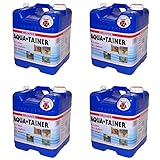
Reliance Aqua-Tainer 7 gal (4-pack)
28 gallons of drinking-water storage across four jugs with spigots
$130.50Check price on Amazon →
Saratoga Farms 5-gal stackable (4-pack)
20 gallons in stackable containers for a closet or garage
$119.98Check price on Amazon →
As an Amazon Associate we earn from qualifying purchases. Amazon prices as of Nov 27, 6:11 AM ET. Prices and deals change often; the price on Amazon at checkout applies.
When the tank runs dry, use stored water, backup power or a hand pump — covered in how to get water from a well without power.
Well homes usually have septic too. Here is how a septic system behaves in a power outage.
Frequently asked questions
How long does a pressure tank last without power?
Only as long as its drawdown lasts. Amtrol lists 5.4 gallons for a 20-gallon tank and 11.8 gallons for a 44-gallon tank at a 40/60 psi setting. With normal use that is minutes, not hours: a few toilet flushes or a short shower.
Why do I get so little water from a big pressure tank?
Most of the tank is air and the room the pump needs to cycle. Only the drawdown, the water pushed out between the switch’s cut-out and cut-in pressure, is usable. On Amtrol’s chart that is roughly a quarter of the tank’s volume at 40/60 psi.
Does a bigger pressure tank help during a power outage?
A little. Amtrol’s 119-gallon WX-350 gives about 32 gallons at 40/60 psi. The EPA puts average home use at 82 gallons per person per day, so stored water or backup power for the pump is still needed.
Can I drink the water left in my pressure tank?
If your well water is normally safe and the well has not flooded, the water in the tank is the same water you drink every day. If the well flooded, don’t drink it until it has been tested. See our guide to power outages and well water.
Will the pump refill the tank when the power comes back?
Normally yes. The pump restarts because the pressure is below cut-in and runs until it reaches cut-out. Some pressure switches have a low-pressure cutoff that keeps the pump off after pressure drops too far. Resetting one means working near live terminals, so call a well contractor or licensed electrician if the pump doesn’t restart.
Sources
- Amtrol, Well-X-Trol Specifications (drawdown chart)
- EPA WaterSense, Statistics and Facts
- EPA WaterSense, Residential Toilets
- EPA WaterSense, Showerheads
- Ready.gov, Water
- EPA, Private Drinking Water Wells
- Franklin Electric, AIM Manual: Submersible Motors (Table 3 generator sizing; Table 29 motor specs)
Run your own numbers
Size a power station for your well pump and the rest of your outage loads.