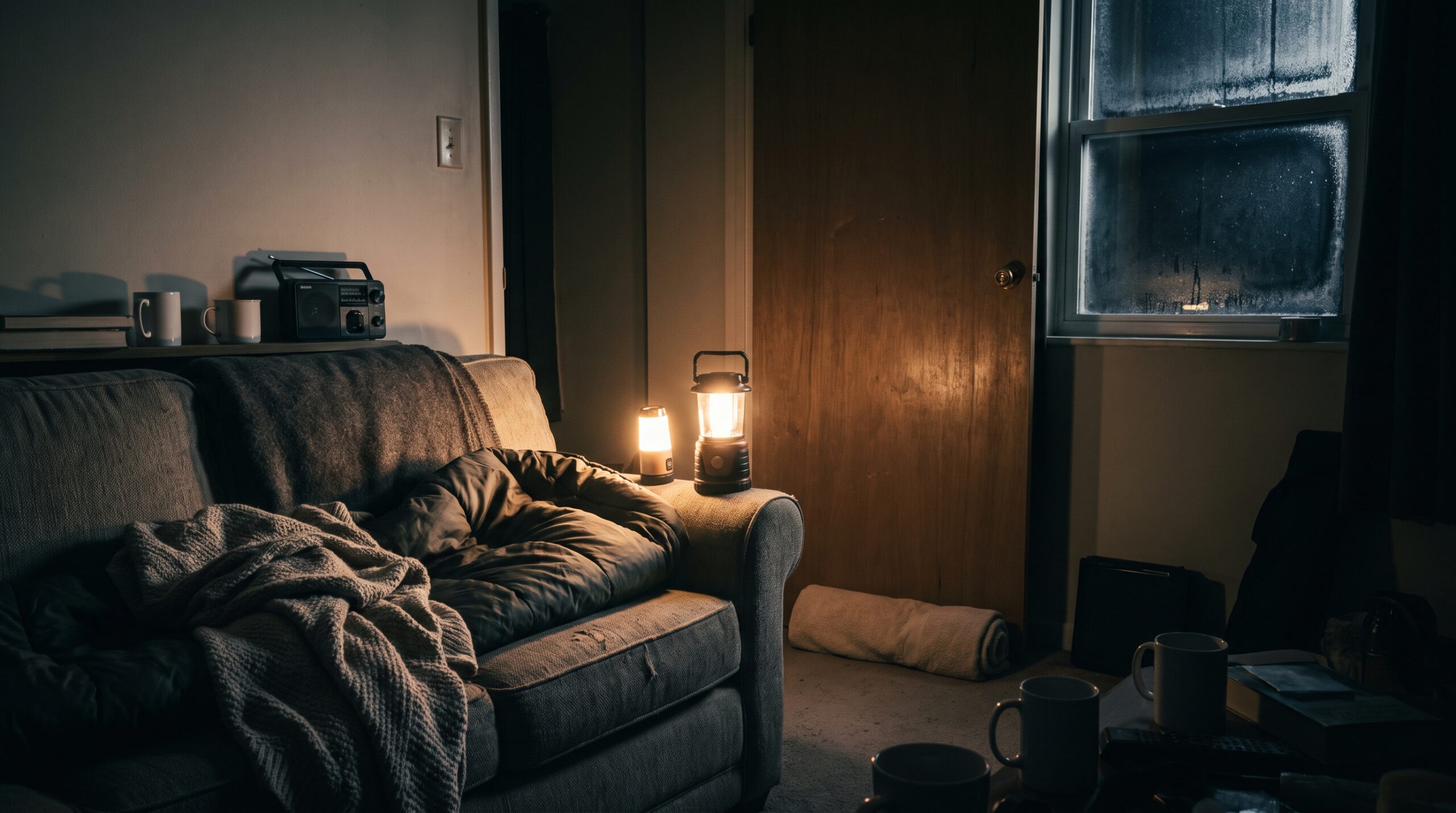
There is no single clock for how long a house stays warm without power. Outdoor cold, insulation, drafts and how many rooms you heat all change the answer, from a couple of hours to a couple of days. In an NREL model of a typical 2,000-square-foot home, indoor temperature crossed a 59°F safety line in about two hours during a cold snap with no mitigation; with added thermal storage that stretched to about 44 hours (NREL, occupant safety in extreme weather).
Ready.gov’s winter and power-outage guidance is to close off unused rooms, dress in layers, never heat with a gas stove or oven, and go to a community warming location if you cannot stay warm (Ready.gov, Winter Weather; Ready.gov, Power Outages). Here is what drives the cooldown, what to do in the first hours, and which low-watt loads fit a power station. For step-by-step warmth tactics, see how to stay warm during a power outage.
What decides how fast a house cools
| Factor | Why it matters | What you can do in an outage |
|---|---|---|
| Outdoor temperature and wind | Bigger indoor-to-outdoor gap means faster heat loss | Close curtains at night; open sunny ones by day (EPA winter IAQ tip) |
| Insulation and air sealing | Leaky, poorly insulated homes cool fastest | Close doors to unused rooms; roll towels at door bottoms |
| House size and open floor plans | Heating the whole shell wastes stored heat | Gather in one interior room |
| Thermal mass (concrete, brick, tile) | Heavy materials release stored heat slowly | Stay near interior walls and floors that were warm before the outage |
| Sun and people | Daytime sun and body heat add a little warmth | Use sunny rooms by day; share blankets at night |
The NREL study used a computer model of a Houston-area home from the 2000s and defined winter “hours of safety” as time above 59°F. Your climate may be colder. Treat the two-hour and 44-hour figures as a researched example of how insulation and thermal storage change the timeline, not a promise for your address (NREL).
What to do in the first hours
- Pick one room and close the rest. Ready.gov’s stay-warm toolkit says to shut doors and close vents in rooms you are not using, and to place a rolled towel at the bottom of doors to block drafts.
- Use the sun by day, close coverings at night. The EPA’s winter indoor-air guidance says to open drapes on sunny windows during the day and close them at night to hold heat (EPA, Winter Weather and Indoor Air Quality).
- Dress in layers and add sleeping bags or blankets. Trying to heat the whole house wastes the warmth you still have.
- Never use a gas stove, oven, charcoal grill or indoor generator for heat. Ready.gov warns that those raise carbon monoxide risk and can cause fires (Ready.gov, Power Outages).
- Protect pipes while you still can. Drip cold water on exterior-wall lines and open sink cabinets. See how to keep pipes from freezing.
- Have a warming-center plan ready if indoor temperatures keep falling or anyone is elderly, very young or has a health condition. Ready.gov says to check with local officials for heating locations.
⚠️ Carbon monoxide
Never heat with a gas stove, oven, charcoal grill, camp stove or a generator indoors, in a garage or on a balcony. Install carbon monoxide alarms with battery backup on every level. Read our carbon monoxide safety guide.
⚠️ Carbon monoxide: run fuel-burning equipment outdoors only
Generators, grills, camp stoves, and other gasoline-, propane-, or charcoal-burning devices give off carbon monoxide, an odorless, colorless gas that can kill within minutes. Never use them inside your home, garage, carport, or basement, or near doors, windows, or vents, even with doors and windows open. Keep a portable generator outdoors at least 20 feet from the house with the exhaust pointed away, and install battery-operated or battery-backup CO alarms. If an alarm sounds or anyone feels dizzy, weak, or sick, get to fresh air right away and call 911. Read our carbon monoxide safety guide (based on CDC and U.S. CPSC guidance).
Passive warmth that does not need much power
Sleeping bags and heavy blankets keep people warm without drawing watts. Use them in one closed room:
Cold-weather sleeping bags, live prices

As an Amazon Associate we earn from qualifying purchases. Amazon prices as of Nov 27, 12:33 PM ET. Prices and deals change often; the price on Amazon at checkout applies.
An electric blanket on a power station uses much less energy than a space heater. A 100W blanket for 8 hours is about 800Wh; a 1,500W heater for the same night is about 12,000Wh. See can a power station run an electric blanket and can a power station run a space heater.
Electric blankets for low-watt personal heat, live prices

Bedsure electric blanket, twin
Flannel heated twin blanket with preheat and auto-off
$52.99Check price on Amazon →
List price $81.99, 35% off (Amazon)

Black Friday Deal
Bedsure heated throw
Smaller heated throw for one person on a couch or chair
$35.12Check price on Amazon →
List price $68.99, 49% off (Amazon)
As an Amazon Associate we earn from qualifying purchases. Amazon prices as of Nov 27, 12:33 PM ET. Prices and deals change often; the price on Amazon at checkout applies.
A mid-size power station for blankets and small loads, live prices

EcoFlow DELTA 3
1,024Wh, 1,800W, 10 ms UPS
$599.00Check price on Amazon →
List price $699.00, 14% off (Amazon)
As an Amazon Associate we earn from qualifying purchases. Amazon prices as of Nov 27, 12:33 PM ET. Prices and deals change often; the price on Amazon at checkout applies.
Which heat loads a power station can actually run
| Load | Typical draw | On a 1,024Wh station* | Reality check |
|---|---|---|---|
| Electric blanket or heated throw | 50–100 W | About 8–17 hours | Best use of limited battery for personal warmth |
| Pipe heat cable (6–24 ft) | About 40–72 W | About 12–20 hours | Protects pipes; thermostat often cycles |
| Furnace blower and controls | Nameplate watts | Varies | See furnace runtime guide |
| 1,500 W space heater | 1,500 W | About 35 minutes | Usually a poor fit; heats the room, empties the battery |
| Whole-house electric heat | Several kW | Minutes | Generator or grid territory |
*Our calculation: watt-hours × 0.85 inverter efficiency ÷ watts, as if the load ran nonstop. Real runtime is shorter with other loads and longer when a thermostat cycles.
Heat cable that a small station can run, live prices
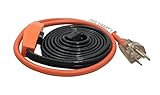
Frost King HC6A heat cable (6 ft)
120V, 7 W/ft (about 42W), thermostat-controlled
$28.79Check price on Amazon →

Black Friday Deal
HEATIT self-regulating heat cable (24 ft)
120V, 3 W/ft, ETL listed, on at 38°F
$26.39Check price on Amazon →
As an Amazon Associate we earn from qualifying purchases. Amazon prices as of Nov 27, 12:33 PM ET. Prices and deals change often; the price on Amazon at checkout applies.
When to leave for a warming center
Ready.gov says to go to a community location with power if heat or cold is extreme (Ready.gov, Power Outages). Leave sooner if anyone shows signs of hypothermia (shivering, confusion, fumbling hands, slurred speech or drowsiness). Ready.gov treats a body temperature below 95°F as an emergency (Ready.gov, Winter Weather). Call local emergency services if those signs appear.
Before winter, Ready.gov also recommends insulation, caulking, weather stripping and carbon monoxide detectors with battery backup. Prep steps are in our winterize your home for power outages guide and power outage checklist.
If you heat with a heat pump, see whether a power station can run a heat pump and for how long.
Free winter storm warning emails: Enter your ZIP. When the National Weather Service issues a winter storm or ice storm warning for your county, you get an email with three things to do before the power goes out. Check your ZIP →
Frequently asked questions
How long will a house stay warm without power?
It depends on outdoor temperature, insulation, drafts and whether you close down to one room. An NREL model of a typical 2,000-square-foot home crossed a 59°F safety line in about two hours in a cold snap with no mitigation, and about 44 hours with added thermal storage. Your home and climate will differ.
What indoor temperature is unsafe in a winter outage?
Ready.gov treats a body temperature below 95°F as a hypothermia emergency. The NREL study used 59°F as a modeled indoor safety threshold for its cold-snap scenario. If you cannot keep people warm, go to a warming center.
Does closing off rooms really help?
Yes. Ready.gov’s stay-warm guidance is to close vents and shut doors in unused rooms and to block drafts under doors so the heat you still have stays in a smaller space.
Can I use my gas oven to heat the house?
No. Ready.gov says never heat your home with a gas stove or oven because of carbon monoxide and fire risk.
Is a space heater a good use of a power station?
Usually not. A 1,500W heater can empty a 1,024Wh station in about half an hour. An electric blanket at 50–100W runs many times longer on the same battery.
How do I keep pipes from freezing while the house cools?
Drip cold water on lines in exterior walls, open sink cabinets, and power heat cable if you have it. See our pipes guide. The Red Cross also advises not letting the thermostat fall below 55°F when you are away under normal powered conditions.
Sources
- NREL, Occupant Safety During Extreme Weather
- Ready.gov, Winter Weather
- Ready.gov, Power Outages
- EPA, Winter Weather and Indoor Air Quality
- American Red Cross, Frozen Pipes
- U.S. CPSC, Portable Electric Heaters
Run your own numbers
Check how long your power station runs an electric blanket, heat cable or furnace blower.