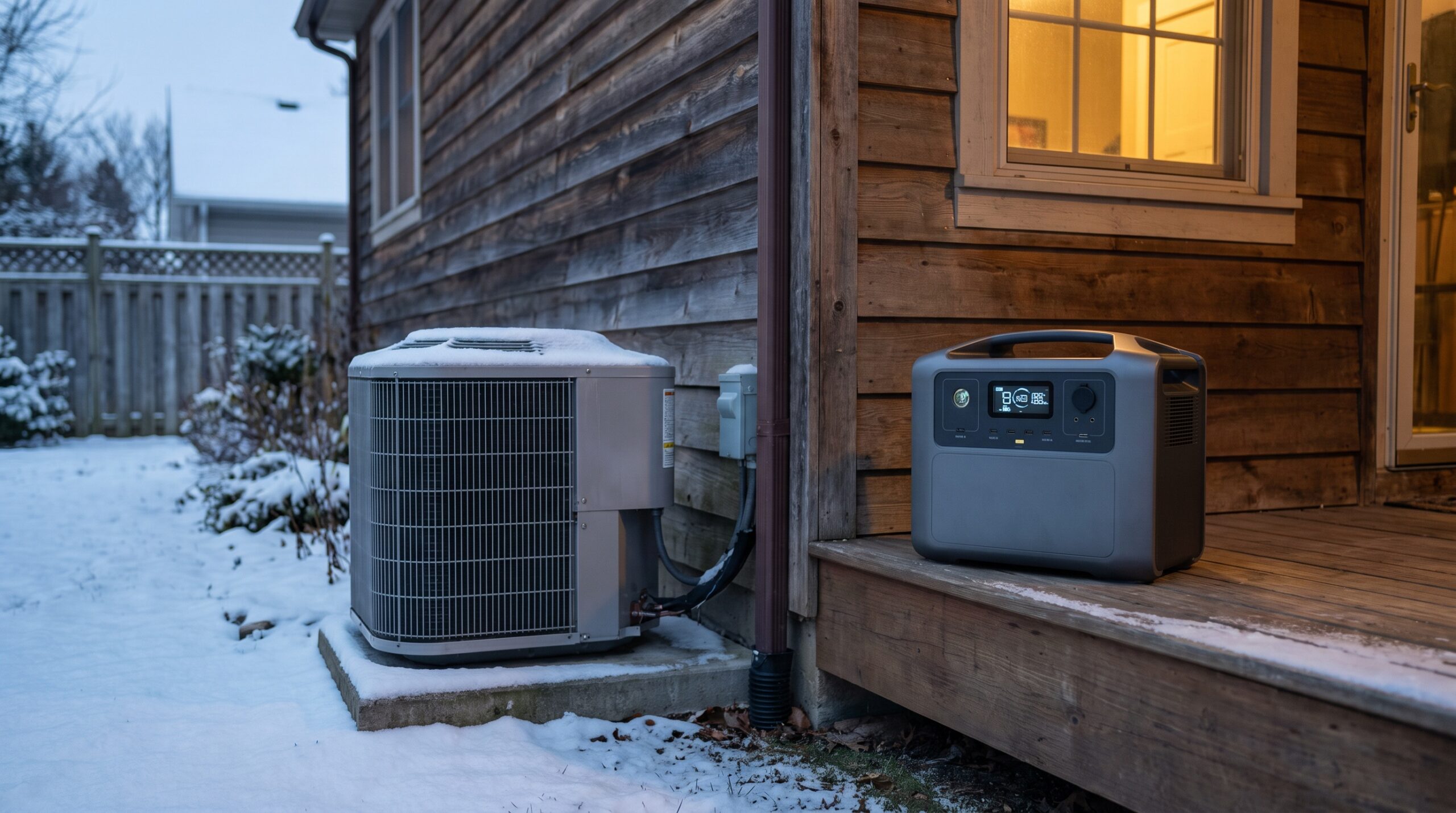
A power station can run a small one-room heat pump (a 120-volt mini-split), which draws about 890 watts while heating according to its maker, MRCOOL. A whole-house central heat pump is a different job: it runs on 240 volts, needs several thousand watts, and has to be connected by an electrician. (MRCOOL spec sheet; Goodman heat pump specifications)
The answer depends on which heat pump you have. One wall unit heating one room is realistic on a mid-size or large power station for a few hours. A ducted system for the whole house is mostly a job for a large 240V battery system or a generator, and even then the electric backup heat inside the air handler can draw far more than any portable unit can supply. The numbers below come from manufacturer spec sheets.
How much power different heat pumps use
These figures come from manufacturer documents. Heat pumps speed up and slow down to match the heat the house needs, so most spec sheets give a range rather than one number.
| Heat pump | Voltage | Power while heating (maker figure) | Notes |
|---|---|---|---|
| MRCOOL Advantage 9,000 BTU mini-split (A-09-HP-C-115D-O) | 115V | 890 W rated (260 to 950 W range) | One-room wall unit; plug-style 120V power stations can supply it |
| MRCOOL Advantage 12,000 BTU mini-split (A-12-HP-C-115D-O) | 115V | 1,065 W rated (200 to 1,230 W range) | Still within a 1,800W+ station’s output |
| Mitsubishi MSZ/MUZ-GL12NA 12,000 BTU mini-split | 208/230V | 1,100 W rated at 47°F, up to 1,620 W; 870 W rated at 17°F, up to 1,240 W | Needs 240V output; a 120V-only station cannot run it |
| Goodman GSZH5 3-ton central heat pump | 208/230V | Compressor 16.0 A running, 91.9 A locked-rotor (start); minimum circuit 22.8 A | Roughly 3,700 W by amps × volts for the compressor alone (our estimate, not a maker wattage) |
| Electric backup heat strips (Goodman HKTS kits) | 240V | 4.8 kW to 19.2 kW | Turn on in very cold weather or in “emergency heat” mode |
The central heat pump wattage is simple arithmetic (16.0 amps × 230 volts ≈ 3,700 watts). Real draw is usually a little lower, and it leaves out the outdoor fan, the indoor blower and any backup heat. Always check the data plate on your own outdoor unit: it lists the voltage, the running amps (RLA) and the starting amps (LRA).
Can my power station run my heat pump? Step by step
- Read the data plate on the outdoor unit. Write down the voltage (115V or 208/230V), the running amps and the starting (locked-rotor) amps, or the rated watts from the spec sheet.
- Match the voltage. A 208/230V heat pump needs a power station or generator with 240V output. Most portable power stations are 120V only, and a bigger battery does not add 240V output.
- Check continuous output. The station’s continuous watts should comfortably exceed the heat pump’s top running figure, plus anything else you plan to run at the same time.
- Check start-up demand. Single-speed central units list a starting current several times the running current (91.9 A vs 16.0 A on the Goodman example). The station’s surge rating has to cover that. If you aren’t sure, see running watts vs starting watts.
- Deal with backup heat. Electric heat strips of 4.8 to 19.2 kW will overload any portable station. Ask your HVAC contractor how to keep them from switching on while you are on backup power.
- Plan the connection. Heat pumps are wired to their own breaker, not plugged into a wall outlet. Feeding one from a power station or generator means a transfer switch or power inlet installed by a licensed electrician.
- Estimate runtime. Divide the station’s usable watt-hours (about 85% of its rating) by the heat pump’s average watts, or use the runtime calculator.
⚠️ Panel, transfer switch, and interlock work: hire a licensed electrician
Installing a transfer switch, a generator interlock kit, a power inlet box, or any connection to your home’s electrical panel is a job for a licensed electrician, and most areas require a permit and inspection. Never backfeed a generator or power station through a wall outlet: it can energize utility lines and electrocute line workers. Power Outage Planner is not an electrical contractor, and this page is general information, not installation advice.
Runtime examples by power station size
Assumptions: about 85% of rated capacity is usable through the inverter, and the heat pump is the only load. The 890 W column uses the MRCOOL 9,000 BTU unit’s rated heating draw. The 450 W column is an example of a unit running at about half power on a milder day, not a maker figure. Real runtime moves with outdoor temperature, thermostat setting and how leaky the house is.
| Power station size | Usable energy (~85%) | Mini-split at 890 W | Mini-split averaging 450 W (example) | 3-ton central at ~3,700 W |
|---|---|---|---|---|
| 1,024Wh (1,800W, 120V) | ~870 Wh | ~1 hour | ~1.9 hours | Can’t run it (120V only) |
| 2,048Wh (2,400W, 120V) | ~1,741 Wh | ~2 hours | ~3.9 hours | Can’t run it (120V only) |
| 3,072Wh (3,600W, 120V) | ~2,611 Wh | ~2.9 hours | ~5.8 hours | Can’t run it (120V only) |
| 3,840Wh (6,000W, 120/240V) | ~3,264 Wh | ~3.7 hours | ~7.3 hours | ~0.9 hour, compressor only, if the surge rating covers the start |
A power station can keep one room comfortable with a small mini-split for an evening or a night on a large unit, but it will not carry a central heat pump through a winter outage. For a whole house you are looking at a large expandable battery system, a home battery, or a generator sized and wired by a professional. See portable power station vs home battery backup and what size generator to run a whole house.
Cheaper ways to stay warm on battery power
The Department of Energy says heat pumps can provide up to three times more heat than the energy they use. On a battery, though, warming your body takes far less energy than warming the room. An electric blanket uses a small fraction of a mini-split’s power: see can a power station run an electric blanket. If you have a gas furnace, its blower is a much smaller load than a heat pump: see how long a power station runs a furnace. For how fast your home loses heat, read how long a house stays warm without power and our guide to staying warm during an outage.
Power stations that fit a heat pump job
Pick the class first. A 120V mini-split needs a station with at least 1,800W continuous output and as much capacity as your budget allows. A 208/230V heat pump needs 240V output, which narrows the field to a few large units. We list current specs from each maker; prices and stock change, so check before you buy. Our best power stations guide compares more models.
120V power stations for a small mini-split, live prices

As an Amazon Associate we earn from qualifying purchases. Amazon prices as of Nov 27, 3:01 PM ET. Prices and deals change often; the price on Amazon at checkout applies.
240V-capable power stations, live prices

Black Friday Deal
Growatt HELIOS 3600
3,686Wh, 3,600W at 120V; one 240V NEMA 6-20 outlet up to 2,200W; 240V split-phase needs two units and the Growatt Split-phase Connector (maker spec)
$1,139.00Check price on Amazon →
List price $1,599.00, 29% off (Amazon)
As an Amazon Associate we earn from qualifying purchases. Amazon prices as of Nov 27, 3:01 PM ET. Prices and deals change often; the price on Amazon at checkout applies.
What about a generator?
A portable generator with a 120/240V outlet can run a central heat pump if it is sized for the start-up current and connected through a transfer switch or interlock. Plan on the compressor, the indoor blower and your other loads, and keep the backup heat strips off. Our transfer switch vs interlock guide explains the options; installation is a job for a licensed electrician.
⚠️ Carbon monoxide: run fuel-burning equipment outdoors only
Generators, grills, camp stoves, and other gasoline-, propane-, or charcoal-burning devices give off carbon monoxide, an odorless, colorless gas that can kill within minutes. Never use them inside your home, garage, carport, or basement, or near doors, windows, or vents, even with doors and windows open. Keep a portable generator outdoors at least 20 feet from the house with the exhaust pointed away, and install battery-operated or battery-backup CO alarms. If an alarm sounds or anyone feels dizzy, weak, or sick, get to fresh air right away and call 911. Read our carbon monoxide safety guide (based on CDC and U.S. CPSC guidance).
Gas and propane generators make carbon monoxide. Run them only outdoors, far from doors and windows, and keep battery CO alarms working inside. Read our carbon monoxide safety guide and how to use a generator safely before you start one.
120/240V portable generators, live prices

Westinghouse 12500W Dual Fuel
12,500 peak / 9,500 running W (gas), 120/240V 14-50R
$999.00Check price on Amazon →

Champion 9375W Dual Fuel
9,375 starting / 7,500 running W on gasoline, CO Shield
$874.99Check price on Amazon →
As an Amazon Associate we earn from qualifying purchases. Amazon prices as of Nov 27, 3:01 PM ET. Prices and deals change often; the price on Amazon at checkout applies.
Battery CO alarms, live prices


As an Amazon Associate we earn from qualifying purchases. Amazon prices as of Nov 27, 3:01 PM ET. Prices and deals change often; the price on Amazon at checkout applies.
For more outage safety basics, see our power outage safety tips.
Frequently asked questions
Can a 2,000Wh power station run a mini-split heat pump?
A 120V mini-split, yes. At the MRCOOL 9,000 BTU unit’s rated 890 W heating draw, a 2,048Wh station gives about 2 hours at full power, and more when the unit slows down on a milder day. It needs a station with enough continuous output, typically 1,800W or more.
Can a power station run a central heat pump?
Only a large one with 240V output, and only for a short time. A 3-ton central unit like the Goodman GSZH5 lists 16.0 running amps at 208/230V, roughly 3,700 W for the compressor alone, so even a 3,840Wh station lasts about an hour. It also has to be wired in by an electrician.
Why can’t my power station run my heat pump even though it has enough watt-hours?
Usually the voltage: most heat pumps are 208/230V and most portable stations put out 120V only. The other common reason is the start-up current, which can be several times the running current on single-speed units.
Can I plug my heat pump into a power station?
Heat pumps are normally wired to their own breaker, not plugged in. Connecting one to a power station or generator safely means a transfer switch or power inlet installed by a licensed electrician.
What about the heat pump’s emergency heat?
Emergency or auxiliary heat uses electric heat strips that draw 4.8 to 19.2 kW in common Goodman kits. That is far beyond any portable power station. Ask your HVAC contractor how to keep it off while you are on backup power.
Is a heat pump or an electric blanket better on battery power?
An electric blanket uses much less power because it warms you, not the room. A heat pump keeps a whole room comfortable but drains the battery many times faster.
Sources
- MRCOOL, Advantage 5th Gen submittal data (A-09-HP-C-115D-O and A-12 models)
- Mitsubishi Electric, Submittal Data: MSZ-GL12NA and MUZ-GL12NA
- Goodman, GSZH5 Split System Heat Pump product specifications
- Amana/Goodman AMVT air handler specifications (HKTS heat kit data)
- U.S. Department of Energy, Energy Saver Guide (heat pumps section)
- Anker, Anker SOLIX F3800 specifications
- Ready.gov, Power Outages
- Ready.gov, Winter Weather
Run your own numbers
Enter your heat pump’s watts from the spec sheet and a battery size to see how long it would run.