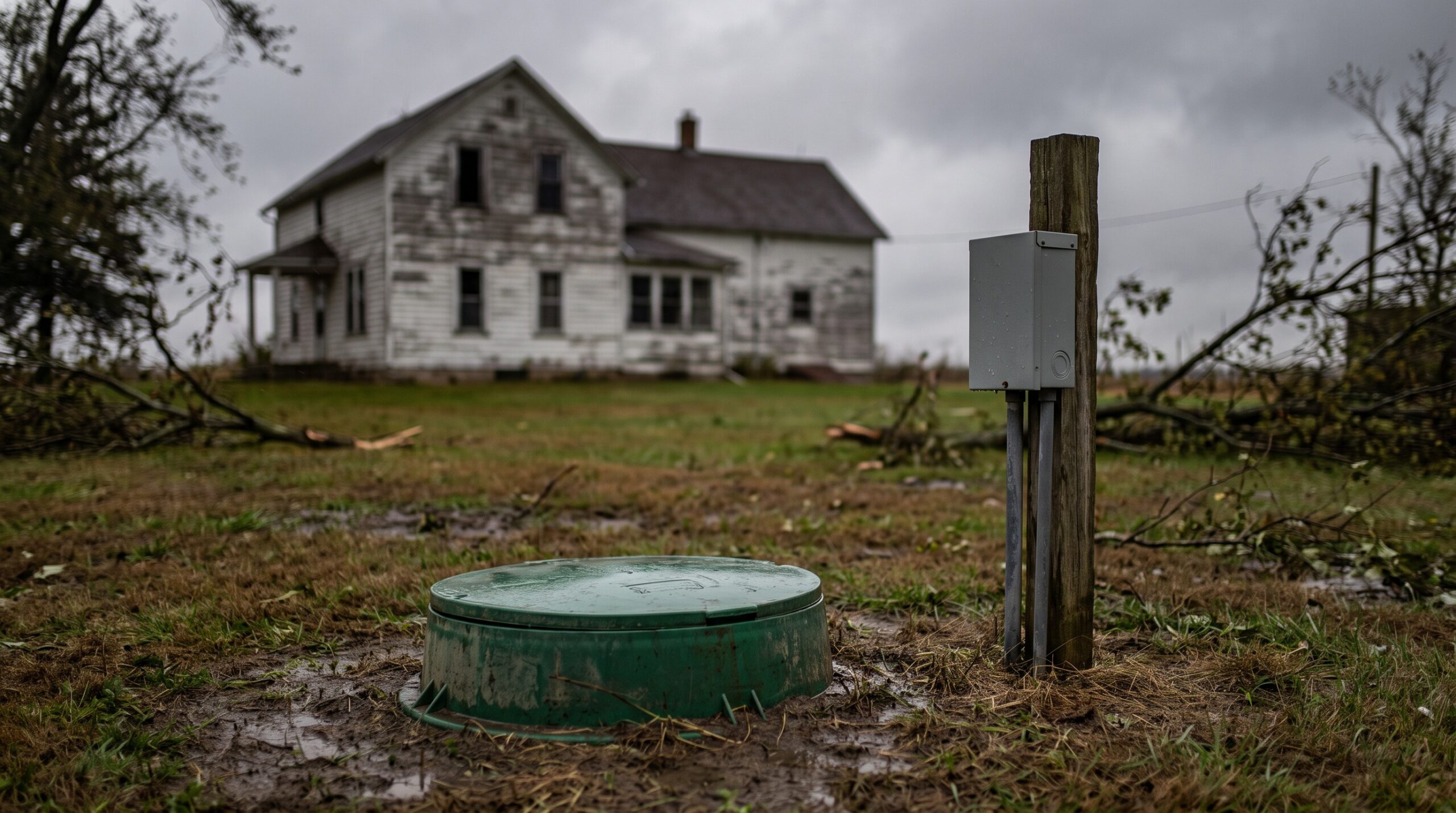
If your septic system works by gravity alone, it keeps working in a power outage and you can flush as usual. If it has a pump, a blower or an alarm panel, the pump stops, wastewater collects in the tank, and you need to cut water use way down until the power is back, or sewage can back up into the house. (NEHA septic power outage guidance; King County Public Health)
Find out which kind you have before an outage. If your water comes from a private well, the well pump stops too, so there may be no water to flush with at all: see how to get water from a well without power.
Which septic systems need power?
| System type | Needs electricity? | What happens in an outage | What to do |
|---|---|---|---|
| Conventional gravity system (tank + drainfield, no pump) | No | NEHA says it should operate normally | Use water normally but sensibly; call a septic pro if drains run slow |
| Pump tank or pressure distribution (mound, drip, low-pressure dosing) | Yes, the pump | Wastewater collects in the tank and is not sent to the drainfield | Cut water use hard; turn off the pump breaker (King County) |
| Aerobic treatment unit or system with a blower | Yes, the blower and controls | Treatment and any pumping stop | Cut water use; have the system checked and restarted after the outage |
| Grinder pump sending waste to a pressure sewer | Yes, the grinder pump | The pump tank fills; E/One says its system has about 24 hours of emergency storage, depending on water use | Minimize all water use until power returns |
EPA explains that a conventional system lets wastewater flow from the tank into the drainfield by gravity, while alternative systems use pumps or gravity to move the liquid through sand, peat or other media. If you have a control panel, an alarm box on a post, or a breaker labeled “septic” or “pump”, your system needs power. Your septic records or a local health department can confirm it.
What to do during the outage
- Find out what type of system you have from your records, the control panel, or the table above. NEHA suggests photographing the tank location and electrical parts ahead of time.
- Cut water use as far as you can. King County’s list: take short showers, don’t wash laundry, don’t let the faucet run while brushing teeth, shaving or rinsing dishes, and don’t flush every time for liquid waste.
- Turn off the septic pump breaker. King County says this keeps the pump from switching back on by itself the moment power returns, when the tank is overfull.
- Watch the drains. If they slow down or sewage appears, stop using water and switch to a temporary toilet (below).
- Stay away from the tank. NEHA warns never to enter a pump chamber or septic tank: the gases are poisonous and the lack of oxygen can be fatal. Turn power off and unplug cords before inspecting anything, and wear rubber gloves and eye protection.
- If sewage has backed up indoors, keep out of that area until it has been disinfected or the contaminated materials removed, as NEHA advises.
After the power comes back: restart the pump slowly
A pump that has been off for hours is sitting on a full tank. If it pumps everything at once, it can flood the drainfield or back up the plumbing. Both agencies below describe short “doses” with long rests in between. Their timings differ, so follow your own system’s maintenance instructions or your septic professional if you have them.
| Source | Pump on | Pump off | Repeat until |
|---|---|---|---|
| King County Public Health (float-controlled pumps) | 2 minutes | 4 to 6 hours | The pump shuts itself off during a dose |
| NEHA (float-controlled pumps off for more than 6 hours) | 5 minutes | 6 hours | The pump turns off automatically during a dosing interval |
- Timer-controlled pumps catch up on their own. King County says to keep conserving water for another day or more; NEHA says to reduce water use for several days.
- High-water alarm going off? That means effluent backed up into the reserve area of the pump tank. Silence it if it has a switch. NEHA says to call a septic professional if it stays on for more than 24 hours. E/One says a grinder pump alarm may sound until the unit clears itself, and to call for service if it is still on more than an hour after power returns.
- Blowers and other powered parts need to restart properly. King County suggests having a maintainer inspect the system once power is back.
- Look for damage before you use the system normally: exposed wiring, odors, wet spots, damaged lids or pipes. NEHA lists these as reasons to call a professional.
Can you run a septic pump on backup power?
Yes. If the pump stays powered, the tank doesn’t fill up and you can use water more normally. Check the pump’s data plate for its watts or amps. Effluent pumps are submersible motors similar to sump pumps, so our sump pump watts guide shows the kind of start-up surge to plan for. Then use the sizing calculator to pick a station or generator size.
Check how the pump is connected. Some pumps plug into a control panel outlet; many are wired straight into a panel on its own breaker. Anything wired into a panel needs a transfer switch or inlet installed by a licensed electrician. Never backfeed a house circuit with an extension cord.
⚠️ Panel, transfer switch, and interlock work: hire a licensed electrician
Installing a transfer switch, a generator interlock kit, a power inlet box, or any connection to your home’s electrical panel is a job for a licensed electrician, and most areas require a permit and inspection. Never backfeed a generator or power station through a wall outlet: it can energize utility lines and electrocute line workers. Power Outage Planner is not an electrical contractor, and this page is general information, not installation advice.
Power stations for a septic or effluent pump, live prices

As an Amazon Associate we earn from qualifying purchases. Amazon prices as of Nov 27, 4:23 PM ET. Prices and deals change often; the price on Amazon at checkout applies.
A gas or propane generator can also run a septic pump. If you use one, follow the carbon monoxide rules every time.
⚠️ Carbon monoxide: run fuel-burning equipment outdoors only
Generators, grills, camp stoves, and other gasoline-, propane-, or charcoal-burning devices give off carbon monoxide, an odorless, colorless gas that can kill within minutes. Never use them inside your home, garage, carport, or basement, or near doors, windows, or vents, even with doors and windows open. Keep a portable generator outdoors at least 20 feet from the house with the exhaust pointed away, and install battery-operated or battery-backup CO alarms. If an alarm sounds or anyone feels dizzy, weak, or sick, get to fresh air right away and call 911. Read our carbon monoxide safety guide (based on CDC and U.S. CPSC guidance).
Run generators only outdoors, away from doors, windows and vents, and keep battery CO alarms inside. Our carbon monoxide safety guide covers the details, and how to choose a generator helps with sizing.
Battery CO alarms, live prices


As an Amazon Associate we earn from qualifying purchases. Amazon prices as of Nov 27, 3:01 PM ET. Prices and deals change often; the price on Amazon at checkout applies.
Set up a temporary toilet if the system is full
NEHA describes temporary toilet options for when no working toilet is available and the outage is expected to last several days. The first choice is staying somewhere with working water and sewer, or renting a portable toilet. If neither works:
- Shut off the water valve to the toilet and flush out the water left in the bowl.
- Line the bowl (under the seat) with a plastic kitchen garbage bag inside a second bag. A 5-gallon bucket with a toilet seat works the same way.
- Add an absorbent such as kitty litter, dry peat moss or lime to the inner bag to soak up liquid and cut odor.
- Keep urine and feces separate if you can; NEHA says this limits odor and makes urine safer to dispose of.
- Wash or sanitize your hands after every use. Keep a bucket of clean water, a dipper and soap nearby.
- Store full bags in a watertight bucket or trash can away from pets, wildlife and children, and dispose of them as local rules allow.
Temporary toilet supplies, live prices

Reliance Double Doodie toilet waste bags (2 x 6)
Double bags with gel powder, fit a 5-gallon bucket toilet
$62.97Check price on Amazon →

Camco toilet waste bags (10-pack)
Leak-proof double bag with absorbent powder
$33.99Check price on Amazon →

Snap-on toilet seat lid for a 5-gallon bucket
Turns a standard bucket into a temporary toilet
$19.95Check price on Amazon →
As an Amazon Associate we earn from qualifying purchases. Amazon prices as of Nov 27, 4:23 PM ET. Prices and deals change often; the price on Amazon at checkout applies.
Put these in your kit with stored water: see how much water to store for a power outage and the power outage checklist. For general safety, read our power outage safety tips.
Frequently asked questions
Can I flush the toilet on a septic system when the power is out?
If your system is gravity-only, yes: NEHA says gravity systems should operate normally in an outage. If it has a pump, flush as little as possible, because wastewater collects in the tank until power returns. King County suggests not flushing every time for liquid waste.
How do I know if my septic system has a pump?
Look for a control panel or alarm box, often on a post or the side of the house, and a breaker labeled for the septic pump. Mound, drip and pressure-dosed systems use pumps. Your septic records or local health department can confirm it.
Should I turn off my septic pump during a power outage?
King County says to turn off the septic pump breaker during an outage so the pump doesn’t switch on by itself when power returns. Then restart it in short doses with long rests in between.
How long can a grinder pump go without power?
E/One says its grinder pump system has about 24 hours of emergency storage, depending on how much water you use. Minimize water use until power is back.
Why is my septic alarm going off after the power came back?
Wastewater backed up into the pump tank’s reserve area during the outage. Silence the alarm if you can and keep conserving water. NEHA says to call a septic professional if the alarm stays on for more than 24 hours.
Can I run my septic pump on a generator?
Yes, if the generator covers the pump’s start-up surge. Pumps wired into a control panel need a transfer switch or inlet installed by a licensed electrician, and the generator must run outdoors only because of carbon monoxide.
Sources
- National Environmental Health Association (NEHA), Guidance for Septic Systems Before, During, and After a Power Outage
- King County (WA) Public Health, What to do during and after a power outage (septic systems)
- EPA, How Septic Systems Work
- Environment One (E/One), Grinder Pump Owner’s Guide (utility-distributed copy)
- Ready.gov, Power Outages
Run your own numbers
Add your septic pump’s watts and the other loads you want to keep running to see what size backup you need.