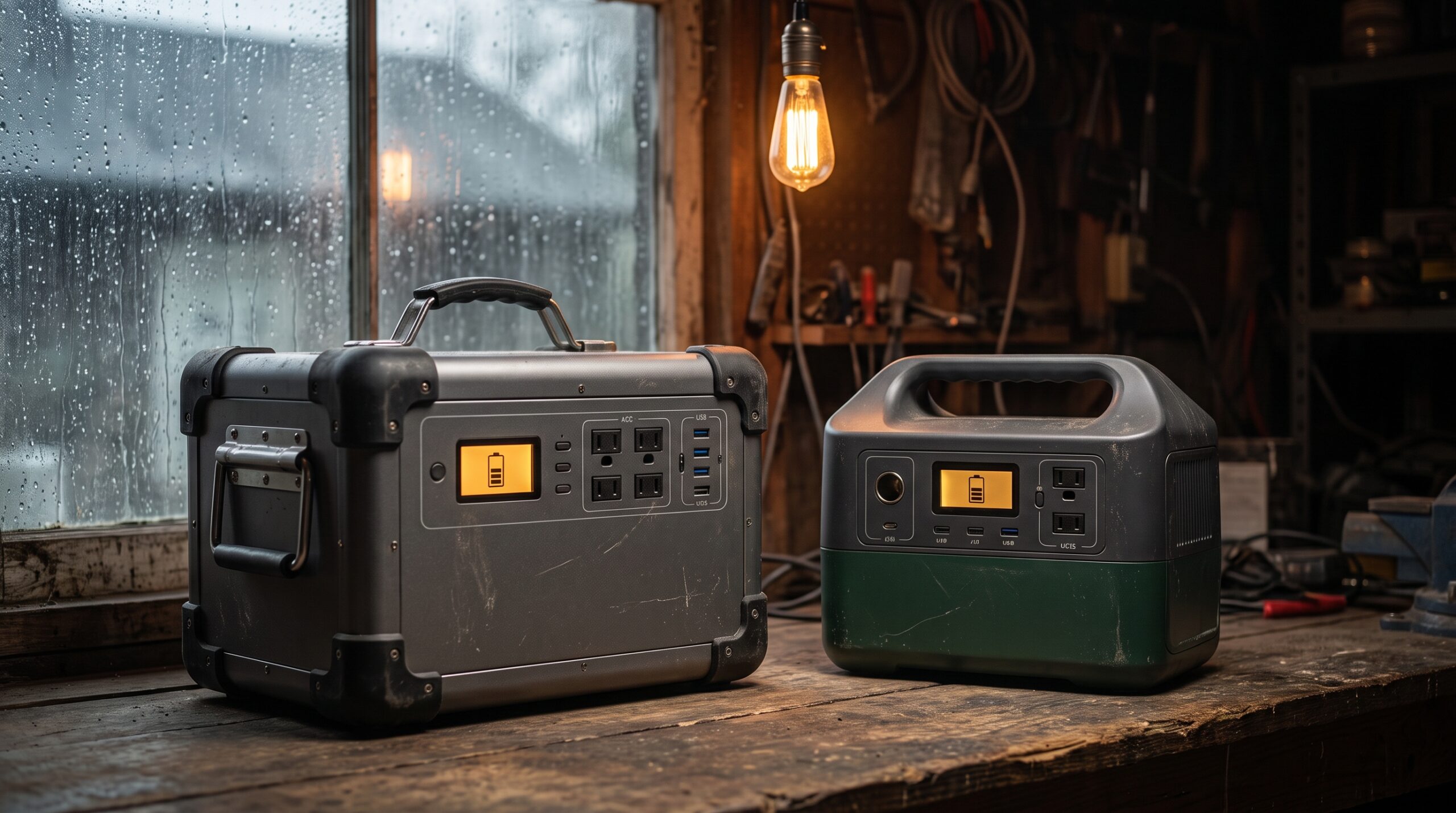
EcoFlow vs Bluetti comes down to the class you are buying. In the 1kWh class, EcoFlow’s DELTA 3 Plus is lighter and expandable to 5kWh, while Bluetti’s AC180 has more capacity (1,152Wh vs 1,024Wh) but cannot be expanded. At 2kWh, the Bluetti AC200L charges faster and expands further. At the 240-volt home-backup level, EcoFlow’s DELTA Pro 3 stores more energy per unit (4,096Wh vs 2,764.8Wh). All figures come from each maker’s spec pages, linked below. Ready.gov advises planning batteries or other alternative power for every item that relies on electricity (Ready.gov).
For the brand-level picture (apps, warranty terms, price per watt-hour, and where Jackery fits), read Jackery vs EcoFlow vs Bluetti. We also compare EcoFlow vs Jackery and Bluetti vs Jackery head to head.
Quick verdict by outage need
- Keep a fridge, WiFi, and lights going through a short outage: either 1kWh unit works. Pick the EcoFlow DELTA 3 Plus if you might add batteries later. Pick the Bluetti AC180 if you want the most watt-hours in a single box.
- Ride out a day-long outage on one unit: the 2kWh class. The Bluetti AC200L charges faster from the wall (2,400W vs 1,800W) and expands to 8,192Wh. The EcoFlow DELTA 2 Max is 12.4 lb lighter.
- Back up home circuits at 240 volts: the EcoFlow DELTA Pro 3 or the Bluetti Apex 300. Connecting either to your home’s electrical panel requires a transfer switch or the maker’s home panel, installed by a licensed electrician.
1kWh class: EcoFlow DELTA 3 Plus vs Bluetti AC180
| Spec | EcoFlow DELTA 3 Plus | Bluetti AC180 |
|---|---|---|
| Capacity | 1,024Wh | 1,152Wh |
| AC output (continuous) | 1,800W (X-Boost 2,200W) | 1,800W |
| Surge / boost mode | 3,600W surge | 2,700W (surge and Power Lifting) |
| Wall charging | 1,500W; 0–100% in 56 min | 1,440W turbo; 0–80% in 45 min |
| Solar input | 1,000W (2 × 500W) | 500W |
| Battery chemistry / cycles | LFP; 4,000 cycles to 80% | LiFePO4; 3,500+ cycles |
| UPS switchover | <10 ms | Not listed on the spec page we used |
| Expandable | Yes, to 5kWh | No |
| Weight | 27.6 lb | 35.3 lb |
| Warranty | 5 years | 5 years |
For outages, the DELTA 3 Plus has three clear advantages: EcoFlow lists a UPS switchover of under 10 ms (EcoFlow), it takes twice the solar input, and you can add batteries later. The AC180 holds 128 more watt-hours and has Power Lifting Mode. Bluetti’s FAQ says this mode lets the unit run higher-wattage heating loads such as space heaters, hair dryers, and electric blankets at reduced power (Bluetti AC180). The AC180’s app control is Bluetooth only.
2kWh class: EcoFlow DELTA 2 Max vs Bluetti AC200L
| Spec | EcoFlow DELTA 2 Max | Bluetti AC200L |
|---|---|---|
| Capacity | 2,048Wh | 2,048Wh |
| AC output (continuous) | 2,400W (X-Boost 3,400W) | 2,400W (Power Lifting 3,600W) |
| Surge | 4,800W | 7,200W |
| Wall charging | 1,800W | 2,400W; 80% in 45 min |
| Solar input | 1,000W (2 × 500W) | 1,200W |
| Battery chemistry / cycles | LFP; 3,000 cycles | LiFePO4; 3,000+ cycles |
| 30A RV outlet | Not listed | TT-30 |
| UPS switchover | Not listed on the spec page we used | 20 ms |
| Expandable | To 6,144Wh | To 8,192Wh (2 × B300) |
| Weight | 50 lb | 62.4 lb |
| Warranty | 5 years | 5 years |
The capacity is identical, so the choice comes down to surge, charging, and weight. The AC200L’s 7,200W surge rating gives it more headroom for motor loads like a well pump or a window AC starting up (Bluetti AC200L). It also refills faster from the wall and expands further. The DELTA 2 Max weighs 12.4 lb less, which matters if you will carry it between rooms or out to a car (EcoFlow DELTA 2 Max). If surge is your deciding factor, read running watts vs starting watts first.
Do the power math →
Runtime ≈ capacity × 0.85 ÷ load watts. On either 2,048Wh unit, a 300 W mix of fridge, WiFi, and lights averages about 2,048 × 0.85 ÷ 300 ≈ 5.8 hours. Enter your real devices in the Appliance Runtime calculator.
240V home backup: EcoFlow DELTA Pro 3 vs Bluetti Apex 300
| Spec | EcoFlow DELTA Pro 3 | Bluetti Apex 300 |
|---|---|---|
| Capacity (single unit) | 4,096Wh | 2,764.8Wh |
| AC output | 4,000W at 120V or 240V (X-Boost 6,000W) | 3,840W (Power Lifting 7,680W) |
| Surge | 8,000W | Not listed separately |
| 120V and 240V | Selected by buttons, not at the same time | Both at the same time |
| Large outlets | TT-30R, 6-20R, L14-30R | TT-30R, 14-50R |
| Solar input | 2,600W (1,600W high-voltage + 1,000W low-voltage) | 2,400W (2 × 1,200W) |
| Wall charging | 0–80% in 50 min | 1,800W standard AC port; 3,840W with the optional hub |
| UPS switchover | 10 ms (<20 ms home switchover with Smart Home Panel 2) | 0 ms per Bluetti’s U.S. product page |
| Maximum expansion | 12kWh per unit; 48kWh system | Up to 6 × B300K batteries; 58kWh system |
| Battery chemistry / cycles | LFP; 4,000 cycles | Not confirmed on Bluetti’s spec page |
| Weight | 113.54 lb | 83.78 lb |
| Warranty | 5 years (3 standard + 2 with app registration) | Not confirmed on Bluetti’s spec page |
The DELTA Pro 3 stores 48% more energy in one unit and lists a higher surge rating, which makes it the stronger single-box choice for a long outage (EcoFlow DELTA Pro 3). The Apex 300 is 29.76 lb lighter, provides 120V and 240V at the same time, and scales to a bigger battery bank (Bluetti Apex 300). Bluetti’s U.S. page advertises a 0 ms switchover, but a Bluetti EU flyer we found lists 20 ms. Confirm the figure for your configuration before you count on it for sensitive equipment.
⚠️ Panel and transfer-switch work is for a licensed electrician
Never back-feed a home through a dryer outlet or any other outlet. Feeding home circuits from either unit requires a transfer switch, interlock, or the maker’s home panel, installed by a licensed electrician. See transfer switch vs interlock and our power outage safety tips.
What both brands get right, and where they differ
- Chemistry: every model here uses LiFePO4 (LFP) cells, the long-life chemistry explained in LiFePO4 vs lithium-ion.
- Warranty: five years on the EcoFlow units and on the AC180 and AC200L. Check the Apex 300 terms on Bluetti’s site.
- Solar: EcoFlow leads in the 1kWh class (1,000W vs 500W). Bluetti leads at 2kWh (1,200W vs 1,000W).
- Expansion: only the Bluetti AC180 cannot add batteries.
For a ranked list across all brands, see the best power stations and the best power station for home backup.
Considering Anker too? Anker SOLIX vs Bluetti compares the two brands size class by size class.
Frequently asked questions
Is EcoFlow or Bluetti better for a power outage?
It depends on the class. In the 1kWh class, EcoFlow’s DELTA 3 Plus is lighter, expandable, and lists a sub-10 ms UPS. At 2kWh, Bluetti’s AC200L has more surge (7,200W) and faster wall charging. For 240V home backup, EcoFlow’s DELTA Pro 3 holds more energy per unit.
Which has a faster UPS switchover, EcoFlow or Bluetti?
EcoFlow lists under 10 ms for the DELTA 3 Plus and 10 ms for the DELTA Pro 3. Bluetti lists 20 ms for the AC200L. Bluetti’s U.S. page claims 0 ms for the Apex 300, but a Bluetti EU flyer says 20 ms.
Can EcoFlow or Bluetti power my house at 240 volts?
The EcoFlow DELTA Pro 3 and Bluetti Apex 300 both output 240V. Connecting either to home circuits requires a transfer switch or the maker’s home panel, installed by a licensed electrician.
Can I add batteries to the Bluetti AC180?
No. The AC180 is not expandable. The EcoFlow DELTA 3 Plus in the same class expands to 5kWh.
How is this different from your Jackery vs EcoFlow vs Bluetti comparison?
That article compares the three brands overall. This one matches specific EcoFlow and Bluetti models class by class on outage features: UPS switchover, surge, charging, solar, and expansion.
Sources
- EcoFlow DELTA 3 Plus, specifications
- EcoFlow DELTA 2 Max, specifications
- EcoFlow DELTA Pro 3, specifications
- Bluetti AC180, specifications and FAQ
- Bluetti AC200L, specifications
- Bluetti Apex 300, specifications
- Ready.gov, Power Outages
Run your own numbers
Add up what you need to run and the sizing calculator will tell you which class fits, whichever brand you choose.