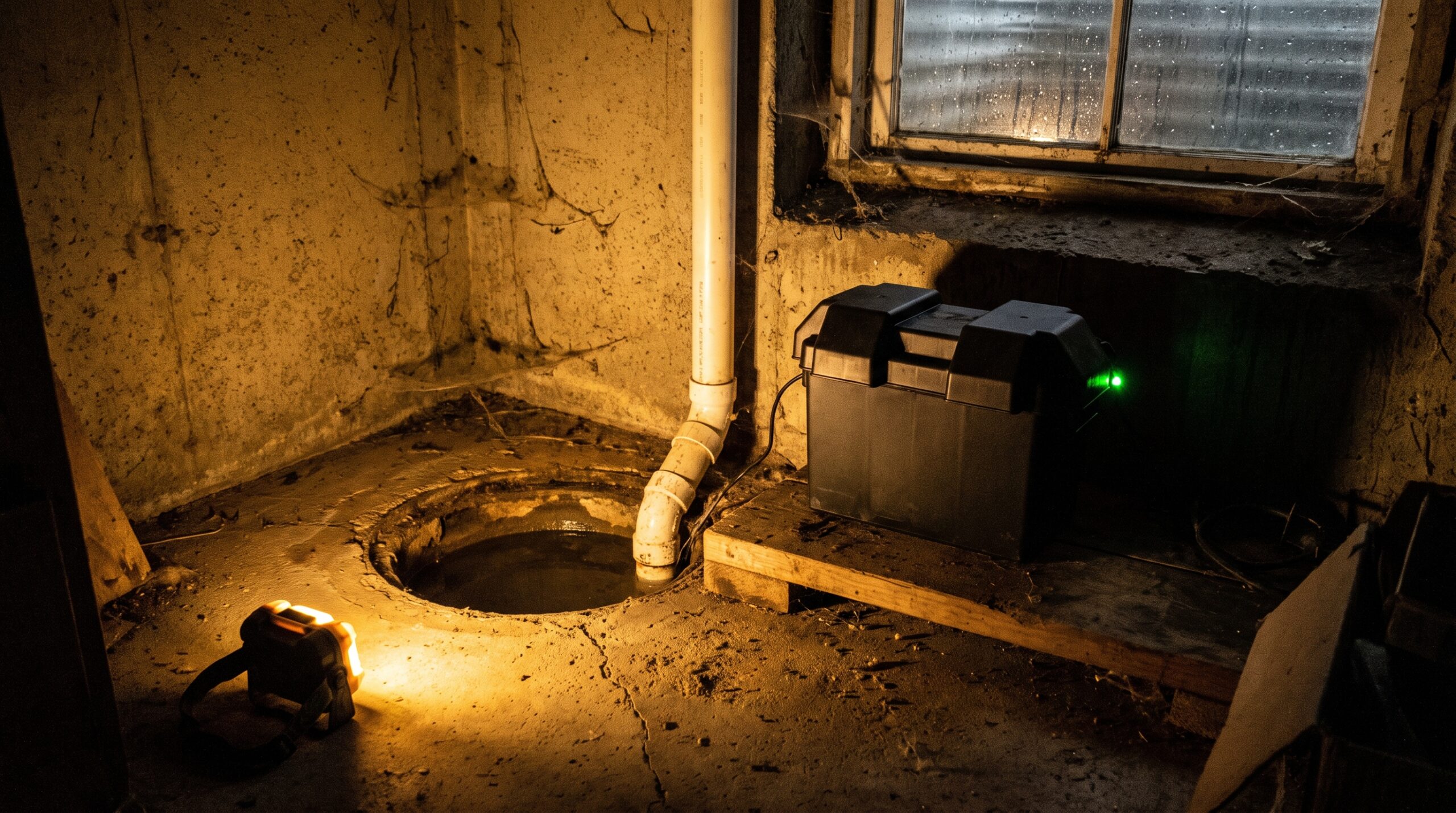
A battery backup sump pump is a second, smaller pump that sits in the sump pit and runs off a 12-volt battery when the power goes out or the main pump fails. The City of Ann Arbor says these pumps usually move about 10 gallons a minute, well below a main pump, and a battery generally gives 7 to 24 hours of pumping. (City of Ann Arbor) Ann Arbor calls it the most popular backup with homeowners, because it starts on its own.
NDSU Extension notes that losing power is the most common reason a sump pump stops, and it often happens in the same thunderstorms and floods when the pump is needed most (NDSU Extension). A backup also helps if the main pump burns out or the float sticks while you are away.
Your backup options at a glance
The City of Ann Arbor compares the common backups like this (City of Ann Arbor):
| Backup | How it works | Good | Limits |
|---|---|---|---|
| Battery backup pump | 12V pump in the pit, battery on the floor nearby, charger keeps it topped up | Starts on its own; also covers a failed main pump | Battery life generally 7 to 24 hours of pumping; batteries need replacing (Ann Arbor says every three years) |
| Water-powered backup | Uses city water pressure to pull water out of the pit | No electricity needed; runs as long as there is water pressure | Uses about 2 gallons of fresh water per gallon pumped; needs a backflow preventer and plumbing work; no use on a private well in an outage |
| Portable generator | Runs the main pump through a heavy-duty cord from outdoors | Can power other things too | Someone must be home to start and refuel it; carbon monoxide risk |
| Standby generator | Starts automatically and powers chosen circuits | Runs longer than a portable generator | Professional install, permit and maintenance |
| High water alarm | Sounds or texts you when the pit rises too high | Cheap early warning | Does not move any water |
How much water a backup pump moves
The higher the pump has to push water up the discharge pipe, the less it moves. This is the maker’s table for one common 12V backup pump, the WAYNE ESP25n (WAYNE Pumps):
| Lift (discharge head) | 0 ft | 5 ft | 10 ft | 15 ft |
|---|---|---|---|---|
| Gallons per hour | 2,700 | 2,100 | 1,500 | 660 |
Measure how high your pipe rises from the pump to where it leaves the house, and read the column closest to that, not the 0-foot number on the box. Wayne says the ESP25n can remove up to 10,000 gallons on a single battery charge. That is the maker’s best case. A pit that fills fast in a heavy storm drains the battery sooner.
How to choose and set up a battery backup, step by step
- Check your pit. The backup has to fit beside the main pump. Wayne, for example, says the ESP25n needs a sump basin 16 inches across or larger. The City of Ann Arbor says the backup goes in slightly higher than the main pump.
- Compare flow at your lift. Use the maker’s table at about the height your pipe rises, not the 0-foot number.
- Get the right battery. NDSU Extension recommends a deep-cycle lead-acid battery and says to buy one with an amp-hour (Ah) rating near the most the pump maker recommends, which it says is typically around 120 Ah. More amp-hours means more hours of protection.
- Use the charger made for the system. NDSU says a regular battery charger won’t do the job except in an emergency.
- Plan the install. Ann Arbor says a battery backup installation generally needs a permit from the local building department. If you are adding a new pit or new discharge piping, hire a licensed plumber.
- Test it. Follow the maker’s test steps and make sure the backup starts, pumps the pit down and shuts off.
- Check the battery every six months for charge and corrosion (NDSU), and keep the alarm switched on.
- Keep the discharge clear. Ann Arbor lists a frozen or blocked discharge pipe as one reason sump pumps fail. In winter, check that the outside end is open and pointed away from the house. See how to keep pipes from freezing.
12V battery backup sump pumps, live prices

WAYNE ESP25n
12V backup pump; Wayne lists 1,500 GPH at 10 ft of lift; battery sold separately
$279.99Check price on Amazon →
List price $347.99, 20% off (Amazon)

Basement Watchdog Special CONNECT (BWSP)
12V backup system with controller, charger and dual float; battery sold separately
$279.00Check price on Amazon →

Zoeller Aquanot 508
12V backup pump with a built-in check valve; battery sold separately
$460.93Check price on Amazon →
As an Amazon Associate we earn from qualifying purchases. Amazon prices as of Nov 27, 7:00 AM ET. Prices and deals change often; the price on Amazon at checkout applies.
Which battery?
Battery size sets how long you are covered. NDSU explains that the amp-hour rating is measured over 20 hours: an 80 Ah battery, for example, supplies 4 amps for 20 hours (NDSU Extension). Buy the battery the pump maker lists for your model. Sealed, maintenance-free batteries skip the job of topping up water, which Ann Arbor mentions for unsealed batteries.
In a long outage when the battery is running down, NDSU says a car or truck battery can power a 12V backup pump in an emergency.
Backup sump pump batteries, live prices

WAYNE WSB1275 battery
12V 75Ah sealed, maintenance-free; made for Wayne backup systems
$299.99Check price on Amazon →

Basement Watchdog BW-27AGM battery
Maintenance-free AGM standby battery for Basement Watchdog systems
$209.00Check price on Amazon →
As an Amazon Associate we earn from qualifying purchases. Amazon prices as of Nov 27, 7:00 AM ET. Prices and deals change often; the price on Amazon at checkout applies.
Water-powered backups
A water-powered backup uses your home’s city water pressure to pull water out of the pit, so it needs no electricity. Ann Arbor lists the trade-offs: it uses about 2 gallons of fresh water for every gallon it pumps, it needs extra piping and a backflow prevention device to keep sump water out of the drinking supply, and that device may need regular testing by a licensed plumber (City of Ann Arbor). It only works while the house has water pressure, so it won’t help on a private well, because the well pump stops in an outage too. Check your local plumbing code before buying one.
Water-powered backup sump pump, live price

Liberty SumpJet water-powered backup
Runs on house water pressure, 20 to 100 psi; no battery
$228.27Check price on Amazon →
As an Amazon Associate we earn from qualifying purchases. Amazon prices as of Nov 27, 7:00 AM ET. Prices and deals change often; the price on Amazon at checkout applies.
Running the main pump on backup power instead
NDSU Extension says that if someone is home in a long outage, a 1,500-watt generator can run the main pump and the battery charger. A battery power station can run a plug-in sump pump indoors with no fumes. Check your pump’s watts and starting surge first: see how many watts a sump pump uses and what size power station for a sump pump. Our best power stations guide compares sizes.
Power stations for a plug-in sump pump, live prices
EcoFlow DELTA 3 Max
2,048Wh, 2,400W (3,400W X-Boost)
$879.00Check price on Amazon →
List price $1,199.00, 27% off (Amazon)

Jackery Explorer 2000 v2
2,042Wh, 2,200W (4,400W peak), 20 ms UPS (maker spec)
$999.00Check price on Amazon →
As an Amazon Associate we earn from qualifying purchases. Amazon prices as of Nov 27, 7:00 AM ET. Prices and deals change often; the price on Amazon at checkout applies.
A gas generator has to stay outdoors. Run a heavy-duty cord rated for outdoor use and for the pump’s load, only as long as you need, and don’t plug more into it than it is rated for.
⚠️ Carbon monoxide: run fuel-burning equipment outdoors only
Generators, grills, camp stoves, and other gasoline-, propane-, or charcoal-burning devices give off carbon monoxide, an odorless, colorless gas that can kill within minutes. Never use them inside your home, garage, carport, or basement, or near doors, windows, or vents, even with doors and windows open. Keep a portable generator outdoors at least 20 feet from the house with the exhaust pointed away, and install battery-operated or battery-backup CO alarms. If an alarm sounds or anyone feels dizzy, weak, or sick, get to fresh air right away and call 911. Read our carbon monoxide safety guide (based on CDC and U.S. CPSC guidance).
Read the carbon monoxide safety guide and how far a generator should be from the house before you start one.
Wiring a generator or power station into your panel to run a hard-wired pump is a job for a licensed electrician.
⚠️ Panel, transfer switch, and interlock work: hire a licensed electrician
Installing a transfer switch, a generator interlock kit, a power inlet box, or any connection to your home’s electrical panel is a job for a licensed electrician, and most areas require a permit and inspection. Never backfeed a generator or power station through a wall outlet: it can energize utility lines and electrocute line workers. Power Outage Planner is not an electrical contractor, and this page is general information, not installation advice.
The panel options are compared in transfer switch vs. interlock.
For the rest of your storm prep, use the power outage checklist and our power outage safety tips.
Michigan homeowners can find state outage data and utility outage maps in our Michigan power outage guide.
Frequently asked questions
How long will a battery backup sump pump run?
The City of Ann Arbor says battery life is generally 7 to 24 hours of pump operation. A sump pump doesn’t run nonstop, so that can stretch longer in a light rain and run out faster in a heavy storm. A bigger battery gives more hours.
Do I need a battery backup sump pump?
The City of Ann Arbor says it depends on your situation: how often you lose power, whether your basement has flooded before, how much is stored there, and how often you are home to deal with a failed pump.
What battery is best for a backup sump pump?
NDSU Extension recommends a deep-cycle lead-acid battery with an amp-hour rating near the most the pump maker recommends, typically around 120 Ah. Use the battery the maker lists for your system.
How often should I replace a sump pump backup battery?
The City of Ann Arbor says batteries must be replaced every three years. NDSU Extension says to check the charge and look for corrosion every six months.
Does a water-powered backup sump pump work on a well?
No. It runs on household water pressure, and a well pump stops when the power goes out. Water-powered backups are for homes on city water, and they need a backflow preventer.
Can I run my sump pump on a generator?
Yes, if someone is home to run it. NDSU Extension says a 1,500-watt generator can run the main pump and the battery charger. Keep the generator outdoors, away from the house, and use a heavy-duty cord rated for outdoor use and the pump’s load.
Sources
- City of Ann Arbor, Sump Pump Backup Options
- NDSU Extension, Electric Backup Sump Pumps for Houses
- WAYNE Pumps, ESP25n 12 Volt Battery Back Up Sump Pump (performance table)
Run your own numbers
Want to keep the main pump running on a power station? Enter the sump pump and anything else you need to see what size backup fits.