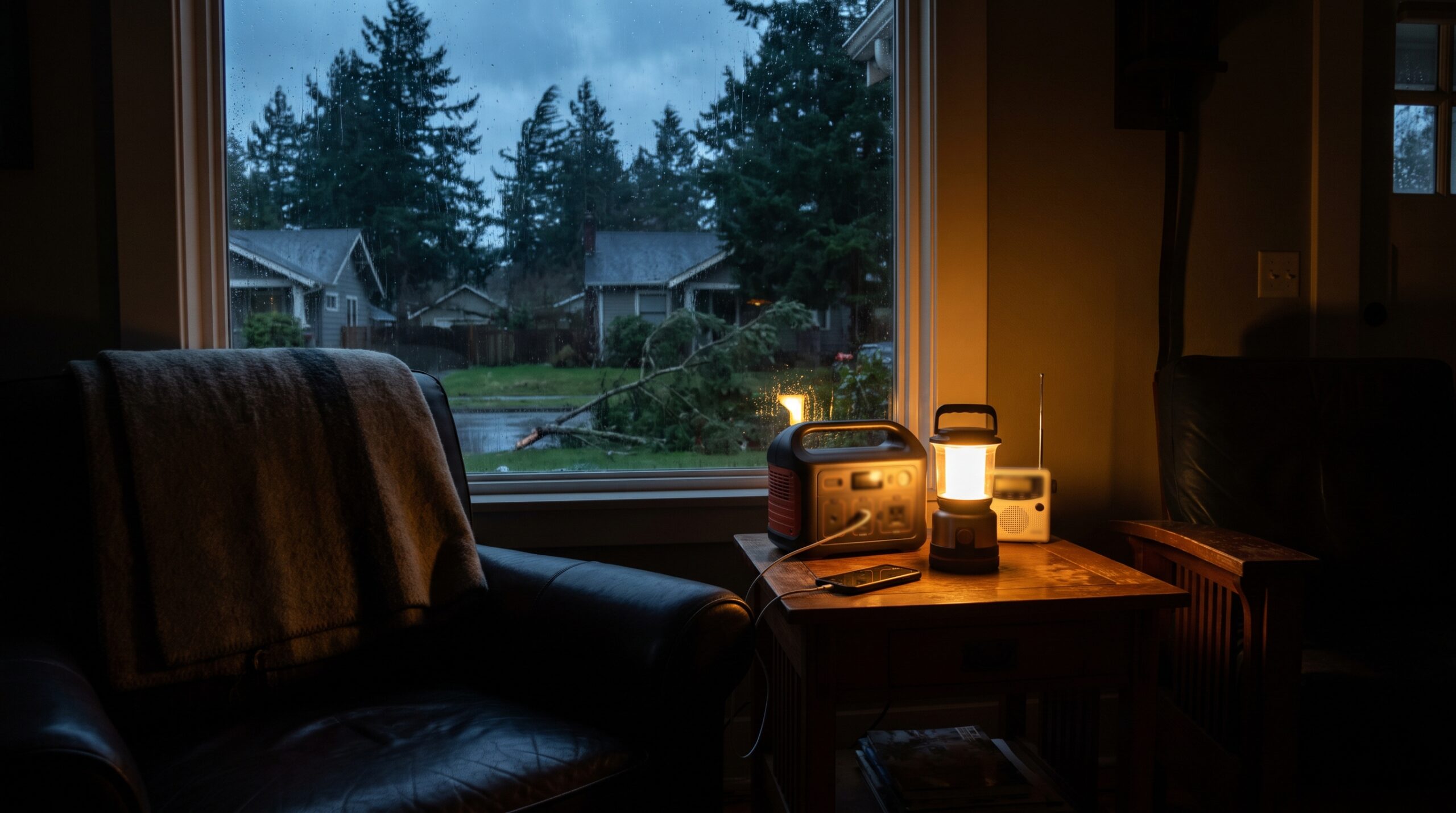
Plan for a Pacific Northwest windstorm to cut your power for a day or more: charge batteries, store water, and have a way to stay warm without the grid. In 2025 the average Washington customer was without power for 6.4 hours and the average Oregon customer for 5.0 hours, both above the U.S. average of 4.5 hours (EIA). When the National Weather Service issues a High Wind Warning, usually for sustained winds of 40 mph or more for an hour or longer, or gusts of 58 mph or more, start the checklist below (NWS).
This guide has 11 years of Washington and Oregon outage data, what the 2024 bomb cyclone and the 2021 ice storms did to the grid, a checklist for each stage of a windstorm, and the utility outage maps to bookmark. For snow and ice, see our winter storm power outage prep and ice storm power outage prep guides.
How long do power outages last in Washington and Oregon?
The U.S. Energy Information Administration publishes the average hours without power per customer for every state each year. We converted its SAIDI figures (minutes per customer per year) into hours. “All events” counts everything, including big storms. “Routine” leaves out major event days, so it shows everyday reliability (EIA, Electric Power Annual, Table 11.4, data for 2025 released October 21, 2026).
| Year | Washington, all events (h) | Washington, routine (h) | Oregon, all events (h) | Oregon, routine (h) | U.S., all events (h) |
|---|---|---|---|---|---|
| 2025 | 6.4 | 2.4 | 5.0 | 1.7 | 4.5 |
| 2024 | 10.7 | 2.6 | 9.7 | 2.1 | 11.0 |
| 2023 | 2.6 | 2.2 | 2.0 | 1.7 | 6.1 |
| 2022 | 6.7 | 2.6 | 5.4 | 2.0 | 5.5 |
| 2021 | 9.2 | 2.5 | 26.5 | 1.9 | 7.9 |
| 2020 | 4.5 | 2.1 | 5.4 | 1.7 | 7.6 |
| 2019 | 5.2 | 1.8 | 3.8 | 1.7 | 4.9 |
| 2018 | 4.4 | 1.9 | 1.9 | 1.5 | 5.8 |
| 2017 | 5.2 | 2.3 | 5.2 | 1.9 | 8.4 |
| 2016 | 4.3 | 2.0 | 3.9 | 1.7 | 4.5 |
| 2015 | 10.3 | 2.0 | 3.8 | 1.7 | 3.5 |
What the numbers show:
- Both states were above the U.S. average in 2025. Washington ranked 11th of all states at 6.4 hours and Oregon 16th at 5.0, while the U.S. average was 4.5.
- Storm days decide the total. In 2025, about 4.0 of Washington’s 6.4 hours and 3.4 of Oregon’s 5.0 hours came on major event days.
- Oregon’s everyday grid is steady, but its storms hit hard. Oregon’s routine outage time was below the U.S. average every year from 2015 to 2025, yet in 2021 its total reached 26.5 hours, the second highest of any state.
- Washington’s routine outages run a little long. Its routine figure was above the U.S. average in 9 of the 11 years. Washington also ranked third of all states in 2015, at 10.3 hours.
- Your outage can be much longer. These are statewide averages per customer. After the worst storms, some homes waited a week, so plan for that.
Compare all 50 states in our power outage statistics by state.
What recent storms did to the grid
The November 2024 bomb cyclone. On Tuesday, November 19, 2024, hurricane-force winds hit Puget Sound Energy’s service area, the largest utility in Washington with about 1.2 million electric customers. Six days later PSE had restored 97 percent of affected customers, but some groups in King County were told to wait until November 26, a full week after the storm. PSE said the work was slow because of the number of fallen trees, broken poles, downed wire and damaged equipment (PSE).
The February 2021 ice storms. Ice, snow and wind storms left 421,649 Portland General Electric customers without power, and one in four of them lost power more than once. PGE crews repaired 12,733 downed wires and issued 984 poles before restoration was complete on February 28 (PGE). Those storms came in the same year as Oregon’s 26.5-hour total in the table above.
In both storms, trees on lines meant days of crew work, street by street, so plan for more than one evening on battery power.
Pacific Northwest windstorm checklist
Before storm season
- Find your utility’s outage page in the table below, sign up for its outage texts, and save its outage phone number.
- Test your carbon monoxide alarms. Ready.gov says to install CO detectors with battery backup on every level of your home.
- Know your water plan. If you are on a well, the pump stops when the power does. See power outage and well water.
- Check your sump pump if your basement or crawl space takes on water in heavy rain. A battery backup sump pump keeps pumping in an outage.
- Build a kit. Our emergency kit builder makes a list for your household.
When a High Wind Warning is issued
- Charge everything. Phones, power banks, a power station, laptop and spare flashlight batteries. Ready.gov suggests a portable charger or power bank and a flashlight for every person.
- Fill water jugs. Our guide on how much water to store has the amounts.
- Bring in or tie down patio furniture, trash cans and anything else the wind can throw.
- Park away from big trees if you can, and fill the car’s gas tank.
- Get your heat plan ready. Gather blankets and read how to stay warm during a power outage.
- Set up a backup for alerts. A NOAA weather radio keeps working when cell service and internet go down (NOAA Weather Radio).
During the outage
- Report the outage to your utility. Don’t assume someone else has.
- Stay away from downed lines and anything touching them, including fallen trees, and report them to the utility.
- Keep the fridge and freezer closed. Ready.gov says a closed fridge keeps food cold for about four hours and a full freezer holds its temperature for about 48 hours.
- Unplug sensitive electronics. Ready.gov warns that power can return with surges that cause damage.
- Never heat your home with a gas stove or oven, and run generators only outdoors, at least 20 feet from windows, doors and attached garages (Ready.gov).
- Go to a warming center if your home gets too cold. Local officials announce which ones are open.
After the power comes back
- Check your food. Ready.gov says to throw out food that has been at 40°F or warmer for two hours or more. See is food safe after a power outage.
- Turn appliances back on one at a time. See what to do when the power comes back on.
- Look for damage to the service line or meter mast on your house. After the 2021 storms, PGE said homes with damaged equipment needed repairs before it could reconnect them.
- Recharge every battery right away. Windstorms often come in a series.
Pacific Northwest utility outage maps
Report outages and check restoration times on your utility’s own page. If you are not sure who serves you, check your bill.
| Utility | Where it serves | Outage page |
|---|---|---|
| Puget Sound Energy (PSE) | Much of Western Washington, including parts of King, Pierce, Thurston, Kitsap, Whatcom and Skagit counties | PSE outage map |
| Seattle City Light | Seattle and nearby cities | Seattle City Light outages |
| Snohomish County PUD | Snohomish County and Camano Island | Snohomish PUD outage map |
| Tacoma Power | Tacoma and nearby areas | Tacoma Public Utilities outages |
| Portland General Electric (PGE) | Portland area and the northern Willamette Valley | portlandgeneral.com or 503-464-7777 / 800-544-1795 |
| Pacific Power | Many parts of Oregon and south-central Washington | pacificpower.net |
| Eugene Water & Electric Board (EWEB) | Eugene | EWEB outages |
| Avista, Clark Public Utilities, other PUDs and co-ops | Their own areas | Use the outage page or phone number on your bill |
Backup power options for a Northwest windstorm
Pick by what has to keep running and for how long. Figures are maker specs, and real runtimes depend on what you plug in.
| Option | Good for | Limits | Safety |
|---|---|---|---|
| Power banks | Phones, small lights | Hours to a day of charging | Safe indoors |
| 1,000Wh power station | Phones, WiFi, lights, a fridge for part of a day | Not enough for electric heat or a heat pump | Safe indoors, no fumes |
| 2,000 to 3,000Wh power station | Fridge, freezer, well pump or sump pump if its watts fit, furnace blower if wired by an electrician | Heavy (about 40 lb and up); solar recharge is slow under winter clouds | Safe indoors, no fumes |
| Portable gas generator | Many circuits for days if you have fuel | Fuel storage, noise; must stay outdoors | Carbon monoxide risk: outdoors only, 20 feet from openings |
| Standby generator | Whole home, automatic | Cost; needs a licensed installer | Installed outdoors to code |
If your home heats with electricity or a heat pump, a portable power station can’t run it for long. See can a power station run a heat pump and how long a house stays warm without power. If you depend on a CPAP, oxygen or other medical device, ask its maker or your provider how to keep it powered, and ask your utility about its medical programs. To size a battery for your own devices, use the calculator below or compare models in the best power stations guide.
1,000Wh class: phones, WiFi, lights and the fridge
1,000Wh power stations, live prices


As an Amazon Associate we earn from qualifying purchases. Amazon prices as of Nov 27, 10:41 AM ET. Prices and deals change often; the price on Amazon at checkout applies.
2,000Wh class: longer outages and pumps
2,000Wh power stations, live prices

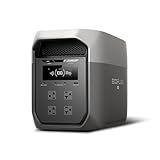
EcoFlow DELTA 3 Max
2,048Wh, 2,400W (3,400W X-Boost)
$879.00Check price on Amazon →
List price $1,199.00, 27% off (Amazon)
As an Amazon Associate we earn from qualifying purchases. Amazon prices as of Nov 27, 10:41 AM ET. Prices and deals change often; the price on Amazon at checkout applies.
Alerts and carbon monoxide alarms
Weather radio and battery CO alarms, live prices


As an Amazon Associate we earn from qualifying purchases. Amazon prices as of Nov 27, 10:41 AM ET. Prices and deals change often; the price on Amazon at checkout applies.
Connecting any generator or power station to your home’s wiring through a panel, inlet or transfer switch is a job for a licensed electrician. Never plug a generator into a wall outlet.
Learn the difference between a transfer switch and an interlock before you call one.
Read our carbon monoxide safety guide before you start a gas generator, and keep our power outage safety tips handy.
For the full list, use the power outage checklist.
Frequently asked questions
How long do windstorm power outages last in the Pacific Northwest?
It depends on the storm. After the November 2024 bomb cyclone, Puget Sound Energy was still restoring some King County customers a week later. In 2025 the average customer was without power for 6.4 hours in Washington and 5.0 hours in Oregon, according to EIA data.
What wind speed causes power outages?
There is no single number, because it depends on the trees and lines near you. The National Weather Service issues a High Wind Warning for sustained winds of 40 mph or more for an hour or longer, or gusts of 58 mph or more. Treat that warning as the signal to get ready for an outage.
Why does the Northwest lose power so often in windstorms?
Most long outages come from trees and branches falling on lines. After the 2024 bomb cyclone, PSE said restoration was slow because of fallen trees, broken poles and downed wire, and PGE repaired 12,733 downed wires after the 2021 ice storms.
Can I run a generator in my garage during a windstorm?
No. Ready.gov says generators must be used only outdoors and at least 20 feet from windows, doors and attached garages, even with the garage door open. Carbon monoxide can kill in minutes.
What size power station do I need for a Northwest outage?
A 1,000Wh station covers phones, WiFi, lights and a fridge for part of a day. For a full day or more, or a well or sump pump, look at 2,000Wh and up. Use the sizing calculator with your own devices.
Sources
- U.S. Energy Information Administration, Electric Power Annual, Table 11.4: SAIDI values by state, 2015 to 2025
- U.S. Energy Information Administration, Electric Power Annual (data for 2025, released October 21, 2026)
- National Weather Service glossary, High Wind Warning
- Puget Sound Energy, Power restored to nearly all PSE customers (November 25, 2024)
- Portland General Electric, Restoration complete from February winter storms (March 1, 2021)
- Ready.gov, Power Outages
- National Weather Service, NOAA Weather Radio
Run your own numbers
List the devices you want to keep running through a windstorm outage to see what size power station fits.