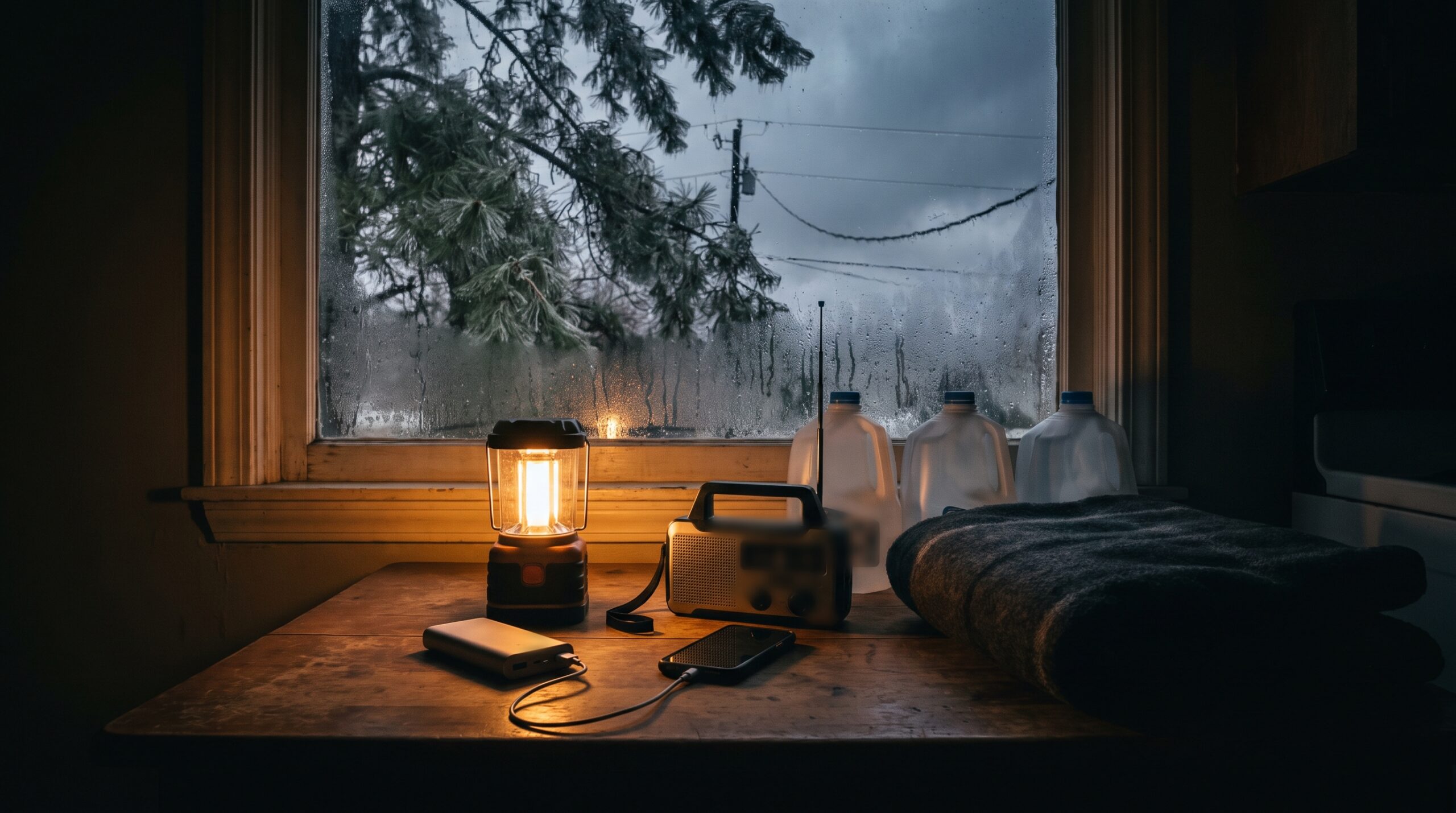
Plan for a Carolinas outage to last several days, and longer in the mountains. In 2024, the year Hurricane Helene hit, the average South Carolina customer went 52.6 hours without power, the most of any state, and North Carolina averaged 25.3 hours (EIA). The Carolinas get two kinds of big outages: hurricanes from June to November and ice storms in winter, when the National Weather Service says as little as a quarter inch of freezing rain can cause widespread outages (NWS Raleigh).
Below are 11 years of outage data for both states, what Helene and the worst ice storms did to the grid, checklists by storm type, cold-weather generator rules and outage maps for every major Carolinas utility. For the general versions, see our ice storm power outage prep and hurricane power outage checklist.
How long do power outages last in North and South Carolina?
The U.S. Energy Information Administration publishes the average hours without power per customer for every state each year. We converted its SAIDI figures (minutes per customer per year) into hours. “All events” counts everything, including hurricanes and ice storms. “Routine” leaves out major event days, so it shows everyday reliability (EIA, Electric Power Annual, Table 11.4, data for 2025 released October 21, 2026).
| Year | NC, all events, h (rank) | SC, all events, h (rank) | U.S., all events (h) | NC, routine (h) | SC, routine (h) | U.S., routine (h) |
|---|---|---|---|---|---|---|
| 2025 | 3.2 (34 of 51) | 2.5 (42 of 51) | 4.5 | 2.4 | 1.7 | 2.1 |
| 2024 | 25.3 (4 of 51) | 52.6 (1 of 51) | 11.0 | 2.4 | 1.9 | 2.2 |
| 2023 | 4.4 (24 of 51) | 2.8 (32 of 51) | 6.1 | 2.6 | 2.1 | 2.1 |
| 2022 | 8.1 (10 of 50) | 5.0 (22 of 50) | 5.5 | 2.5 | 1.9 | 2.2 |
| 2021 | 3.6 (28 of 50) | 2.0 (41 of 50) | 7.9 | 2.1 | 1.7 | 2.1 |
| 2020 | 7.3 (16 of 51) | 5.5 (23 of 51) | 7.6 | 2.4 | 2.0 | 1.9 |
| 2019 | 4.8 (16 of 51) | 5.6 (10 of 51) | 4.9 | 2.5 | 1.8 | 2.0 |
| 2018 | 31.3 (1 of 51) | 8.1 (11 of 51) | 5.8 | 2.8 | 2.3 | 2.0 |
| 2017 | 4.7 (21 of 51) | 6.4 (14 of 51) | 8.4 | 2.5 | 2.0 | 1.9 |
| 2016 | 14.3 (2 of 51) | 28.3 (1 of 51) | 4.5 | 2.5 | 2.0 | 2.0 |
| 2015 | 3.7 (23 of 51) | 3.9 (21 of 51) | 3.5 | 2.2 | 2.0 | 1.9 |
What the numbers show:
- Storm years blow up the averages. South Carolina ranked first of all states in 2016 (28.3 hours) and 2024 (52.6 hours). North Carolina ranked first in 2018 (31.3 hours), second in 2016 and fourth in 2024. Those are the years of Hurricanes Matthew (2016), Florence (2018) and Helene (2024).
- Helene’s year was extreme even by U.S. standards. In 2024 the U.S. average was 11.0 hours. South Carolina’s 52.6 hours was almost five times that.
- On a normal day, North Carolina’s grid has a little more downtime than average. Its routine outage time was 2.1 to 2.8 hours a year from 2015 to 2025, above the U.S. figure every year. South Carolina’s routine figure ranged from 1.7 to 2.3 hours.
- In a quiet year, outages are short. In 2025 the average customer was without power for 3.2 hours in North Carolina and 2.5 hours in South Carolina, against 4.5 hours for the U.S.
- Your outage can be far longer than the average. These are statewide averages per customer. After Helene, some mountain communities waited weeks, so plan for that.
Compare all 50 states in our power outage statistics by state, or read how long power outages last in general.
What the biggest Carolinas storms did to the grid
Hurricane Helene, 2024. Helene’s damage reached far inland. North Carolina outages peaked at more than one million customers (NC Department of Public Safety). In South Carolina, about 1.4 million customers were without power at the peak on September 27, 2024, and it took about two weeks to restore them. Utilities in the state replaced more than 14,000 poles and 6,000 transformers, and 99% of Duke Energy’s Upstate customers lost power (SC Office of Regulatory Staff).
On October 5, about a week after the storm, Duke Energy said it had restored 90% of Carolinas customers who could take power, but about 141,000 outages remained in the North Carolina mountains (Duke Energy). In Asheville, power came back to more than half of customers within a week, but clean water was not restored to the city until November 18, 53 days after the storm (National Hurricane Center). If you are on city water, a long outage can also mean a long water problem.
The December 2002 ice storm. On December 4 and 5, 2002, up to one inch of ice covered 40 North Carolina counties and about two million customers lost power (NC Utilities Commission). At the peak, 1,042,034 of Duke Power’s 1,675,361 North Carolina customers (62%) were out, and Progress Energy had 460,400 out, mostly around Raleigh, Cary and Henderson (NC Utilities Commission). Forecasts two days ahead called for about a quarter inch of ice. In most of central North Carolina, the final total was more than double what was expected. Duke Power called it the worst storm in its 100-year history, with over 1.5 million customers losing power (NWS Raleigh).
Winter Storm Fern, January 2026. It was a smaller ice storm, and a recent one. By the afternoon of January 26, Duke Energy had restored power to more than 131,000 Carolinas customers, with nearly 22,000 still out. Its storm director said the worst equipment damage was along the Blue Ridge Escarpment, in places like Hendersonville, Travelers Rest and Clemson (Duke Energy).
Forecasts can miss, and damage in the mountains and foothills takes the longest to fix. Plan as if your street will be among the last ones back.
Ice storm and hurricane alerts: when to do what
The National Weather Service and the National Hurricane Center use these alerts. For your power plan, the timing is the useful part (NWS Raleigh criteria, NWS Raleigh winter terms, NHC glossary).
| Alert | What it means | What to do about power |
|---|---|---|
| Winter Storm Watch | Heavy snow, damaging ice or a blizzard is possible; typically issued 24 to 48 hours ahead | Charge everything, check fuel, batteries and CO alarms |
| Ice Storm Warning | Freezing rain is expected to build up to a quarter inch or more (NWS Raleigh); damaging ice within 12 to 36 hours | Expect outages; finish prep, fill water, get warm layers out |
| Freezing Rain or Winter Weather Advisory | Lighter ice or snow that makes travel risky | Charge devices; stay off the roads |
| Hurricane Watch | Winds of 74 mph or more are possible; issued 48 hours before tropical-storm-force winds are expected | Charge everything, fill water, get fuel |
| Hurricane Warning | Winds of 74 mph or more are expected; issued 36 hours before tropical-storm-force winds are expected | Finish prep now, or leave if officials order it |
Carolinas power outage checklist
Before the season
- Find your utility’s outage page in the table below, sign up for its outage texts, and save its outage phone number.
- On the coast, know your evacuation zone. North Carolina has zones in 21 coastal counties (NC Know Your Zone), and South Carolina’s coastal counties use the same system (SC Know Your Zone). Local officials order evacuations by zone.
- Test your carbon monoxide alarms. Ready.gov says to install CO detectors with battery backups on every level of your home (Ready.gov).
- If someone in your home relies on electric medical equipment, ask the equipment maker or your provider how to keep it running, and ask your utility about its medical programs.
- Decide on backup power now, not when stores are sold out. Our generator or power station guide helps you pick.
- Build a kit. Our emergency kit builder makes a list for your household.
When an ice storm is in the forecast
- Charge everything. Phones, power banks, a power station and spare flashlight batteries.
- Get supplies for several days at home. Ready.gov says to gather supplies in case you need to stay home for several days without power, and to keep a full tank of gas (Ready.gov).
- Get warm gear ready. Blankets, sleeping bags and layers for everyone. See how to stay warm during a power outage.
- Protect your pipes. See how to keep pipes from freezing during a power outage.
- Fill water jugs. Our guide on how much water to store has the amounts. If you are on a well, the pump stops when the power does.
- Set up a backup for alerts. A NOAA weather radio keeps working when cell service and internet go down (NOAA Weather Radio).
When a Hurricane Watch is issued
- Charge everything and fill water jugs, as above.
- Get fuel for the car and the generator, and store it safely. See how to store gasoline safely.
- Fill empty freezer space with containers of water and let them freeze. Ready.gov says a full freezer holds its temperature for about 48 hours.
- Inland and in the mountains, plan for flooding and blocked roads, not just wind. Helene did its worst damage in the mountains of western North Carolina (NHC).
- Leave right away if officials tell you to evacuate, as Ready.gov advises (Ready.gov).
During the outage
- Report the outage to your utility once it is safe. Don’t assume someone else has.
- Stay away from downed lines. Dominion Energy says to stay at least 30 feet away and call to report them. North Carolina’s electric co-ops warn that limbs weakened by ice can still fall and cause outages after the storm passes (NC Electric Cooperatives).
- Keep the fridge and freezer closed. Ready.gov says a closed fridge keeps food cold for about four hours and a full freezer holds its temperature for about 48 hours.
- Never heat your home with a gas stovetop or oven. Ready.gov warns this risks carbon monoxide poisoning and fires (Ready.gov).
- Run a generator only outdoors, at least 20 feet from windows, doors and attached garages (Ready.gov). Never run one in a garage, even with the door open.
- Stay off icy roads if you can, and stay inside if you get trapped in your car (Ready.gov).
After the power comes back
- Check your food. Ready.gov says to throw out food that has been at 40°F or warmer for two hours or more. See is food safe after a power outage.
- Turn appliances back on one at a time. See what to do when the power comes back on.
- Look for damage to the meter, the line to your house or anything that got wet. Have a licensed electrician check damage on your side before you use it.
- Recharge every battery right away. Limbs weakened by ice can still fall and knock lines down after the storm has passed.
Using a generator safely in a Carolinas ice storm
A gas generator can keep a fridge, a furnace fan and lights going for days, as long as you have fuel. Its exhaust also has carbon monoxide, which can kill in minutes. Winter makes this worse, because people are tempted to shut doors and windows and keep the generator close.
- Set it up outdoors, at least 20 feet from the house, with the exhaust pointed away from windows, doors and vents. Our guide on how far a generator should be from the house explains why.
- Keep it dry. Ready.gov says to keep the generator dry and protected from rain or flooding, because touching a wet generator can cause shock (Ready.gov). Read can you run a generator in the rain for freezing rain too.
- Plug appliances straight into the generator with heavy-duty, outdoor-rated cords sized for the load. Duke Energy says never to wire a generator directly into your breaker box, because it can backfeed power lines and injure line crews (Duke Energy).
- Size it to your loads. Use our guide to what size generator you need.
- Shut it off and let it cool before refueling. Ready.gov warns that fuel spilled on hot engine parts can ignite. Our generator safety guide covers the rest.
⚠️ Carbon monoxide: run fuel-burning equipment outdoors only
Generators, grills, camp stoves, and other gasoline-, propane-, or charcoal-burning devices give off carbon monoxide, an odorless, colorless gas that can kill within minutes. Never use them inside your home, garage, carport, or basement, or near doors, windows, or vents, even with doors and windows open. Keep a portable generator outdoors at least 20 feet from the house with the exhaust pointed away, and install battery-operated or battery-backup CO alarms. If an alarm sounds or anyone feels dizzy, weak, or sick, get to fresh air right away and call 911. Read our carbon monoxide safety guide (based on CDC and U.S. CPSC guidance).
To run house circuits from a generator, you need a transfer switch or an interlock installed by a licensed electrician. Learn the difference in transfer switch vs. interlock before you call one.
⚠️ Panel, transfer switch, and interlock work: hire a licensed electrician
Installing a transfer switch, a generator interlock kit, a power inlet box, or any connection to your home’s electrical panel is a job for a licensed electrician, and most areas require a permit and inspection. Never backfeed a generator or power station through a wall outlet: it can energize utility lines and electrocute line workers. Power Outage Planner is not an electrical contractor, and this page is general information, not installation advice.
Carolinas utility outage maps
Report outages and check restoration times on your utility’s own page. If you are not sure who serves you, check your bill. Many Carolinians are served by an electric co-op or a city utility, not one of the big companies. North Carolina also runs a statewide outage page that pulls data from Duke Energy, Dominion Energy, the NC electric co-ops and ElectriCities about every 30 minutes.
| Utility | State | Outage map or phone |
|---|---|---|
| Duke Energy Carolinas and Duke Energy Progress | NC and SC | Duke Energy outages; in NC call (800) 769-3766 (Duke Energy) or (800) 419-6356 (Duke Energy Progress) |
| Dominion Energy | Northeastern NC | Dominion Energy outages or (866) 366-4357 |
| NC electric cooperatives | NC | Statewide co-op outage map; phone numbers on the NC DPS outage page |
| Dominion Energy South Carolina | SC | Dominion Energy SC outage map |
| Santee Cooper | SC | Santee Cooper storm center and outages |
| Electric Cooperatives of South Carolina | SC | SC co-op outage map and how to report an outage |
| City utilities (ElectriCities members and others) | NC and SC | The outage page or phone number on your bill |
Backup power options for a Carolinas outage
Pick by what has to keep running and for how long. Figures are maker specs, and real runtimes depend on what you plug in.
| Option | Good for | Limits | Safety |
|---|---|---|---|
| Power banks | Phones, small lights, a radio | Hours to a day of charging | Safe indoors |
| 1,000Wh power station | Phones, WiFi, lights, a fridge for part of a day, an electric blanket | Not enough for electric heat or central air | Safe indoors, no fumes |
| 2,000 to 3,000Wh power station | Fridge, freezer, a gas furnace blower if its watts fit | Heavy (about 40 lb and up); recharging needs sun or a generator | Safe indoors, no fumes |
| Portable gas generator | Many circuits for days if you have fuel | Fuel runs out; roads may be iced or blocked; noise; must stay outdoors | Carbon monoxide risk: outdoors only, 20 feet from openings |
| Standby generator | Whole home, automatic | Cost; needs a licensed installer | Installed outdoors to code |
A portable power station can’t heat a house. See can a power station run a space heater, can a power station run a heat pump and can a power station run an electric blanket. If you depend on a CPAP, oxygen or other medical device, ask its maker or your provider how to keep it powered. To size a battery for your own devices, use the calculator below or compare models in the best power stations guide and the best portable generators guide.
1,000Wh class: phones, WiFi, lights and the fridge
1,000Wh power stations, live prices


As an Amazon Associate we earn from qualifying purchases. Amazon prices as of Nov 27, 2:51 AM ET. Prices and deals change often; the price on Amazon at checkout applies.
2,000Wh class: longer outages
2,000Wh power stations, live prices

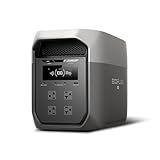
EcoFlow DELTA 3 Max
2,048Wh, 2,400W (3,400W X-Boost)
$879.00Check price on Amazon →
List price $1,199.00, 27% off (Amazon)
As an Amazon Associate we earn from qualifying purchases. Amazon prices as of Nov 27, 2:51 AM ET. Prices and deals change often; the price on Amazon at checkout applies.
Dual-fuel generators (outdoors only)
Dual-fuel portable generators, live prices

Champion 4500W Dual Fuel Inverter
4,500 starting / 3,500 running W, CO Shield
$999.00Check price on Amazon →

Westinghouse 12500W Dual Fuel
12,500 peak / 9,500 running W (gas), 120/240V 14-50R
$999.00Check price on Amazon →
As an Amazon Associate we earn from qualifying purchases. Amazon prices as of Nov 27, 2:51 AM ET. Prices and deals change often; the price on Amazon at checkout applies.
Alerts and carbon monoxide alarms
Weather radio and battery CO alarms, live prices


As an Amazon Associate we earn from qualifying purchases. Amazon prices as of Nov 27, 2:51 AM ET. Prices and deals change often; the price on Amazon at checkout applies.
Read our carbon monoxide safety guide before you start a gas generator, and keep our power outage safety tips handy. For the full list, use the power outage checklist. In Florida? See our Florida hurricane power outage guide.
Frequently asked questions
How long does the power stay out after a big storm in the Carolinas?
Most homes get power back within days, but the hardest-hit areas can wait weeks. After Hurricane Helene in 2024, it took about two weeks to restore South Carolina customers, according to the SC Office of Regulatory Staff, and about 141,000 outages were still left in the North Carolina mountains about a week after the storm, according to Duke Energy.
How much ice does it take to knock out power?
The National Weather Service office in Raleigh says as little as a quarter inch of freezing rain can cause widespread power outages, and it issues an Ice Storm Warning when a quarter inch or more is expected. In the December 2002 ice storm, up to one inch of ice fell and about two million North Carolina customers lost power.
Can I run a generator in my garage during an ice storm?
No. Ready.gov says generators must be used only outdoors and at least 20 feet from windows, doors and attached garages. Carbon monoxide can kill in minutes, even with the garage door open. Set it up outside and keep it dry.
Can I plug my generator into my house?
Not through a wall outlet or by wiring it into the breaker box. Duke Energy warns this can backfeed power lines and injure line crews. Plug appliances straight into the generator, or have a licensed electrician install a transfer switch or interlock.
How do I check outages across North Carolina?
The NC Department of Public Safety runs a statewide power outage page that updates about every 30 minutes with data from Duke Energy, Dominion Energy, the NC electric cooperatives and ElectriCities. For your own address, use your utility’s outage map.
Can I use my gas oven to heat the house when the power is out?
No. Ready.gov says never to heat your home with a gas stovetop or oven, because of the risk of carbon monoxide poisoning and fire. Use warm layers and blankets, and keep battery CO alarms on every level.
Sources
- U.S. Energy Information Administration, Electric Power Annual, Table 11.4: SAIDI values by state, 2015 to 2025
- NC Department of Public Safety, Hurricane Helene response update (September 30, 2024)
- South Carolina Office of Regulatory Staff, Understanding Helene’s Effects on Energy and Communications Resilience (March 2026)
- Duke Energy, Duke Energy restores 90% of Carolinas customers capable of receiving power following Helene (October 5, 2024)
- National Hurricane Center, Tropical Cyclone Report: Hurricane Helene
- NC Utilities Commission, Response of Electric Utilities to the December 2002 Ice Storm
- NC Utilities Commission, December 2002 ice storm report, executive summary
- National Weather Service Raleigh, Remembering the December 2002 Winter Storm (newsletter)
- Duke Energy, Duke Energy restores power to 131,000 following Fern (January 26, 2026)
- National Weather Service Raleigh, Weather criteria
- National Weather Service Raleigh, Winter preparedness
- National Hurricane Center, Glossary of NHC Terms
- NC Department of Public Safety, Power Outages
- NC Emergency Management, Know Your Zone
- SC Emergency Management Division, Know Your Zone
- Ready.gov, Winter Weather
- Ready.gov, Hurricanes
- Ready.gov, Power Outages
- Dominion Energy, Report Outage or Emergency
- North Carolina’s Electric Cooperatives, Winter Storm Fern: Latest Updates
- National Weather Service, NOAA Weather Radio
Run your own numbers
List the devices you want to keep running through a storm outage to see what size power station fits.